The Chronicle of Epic Words
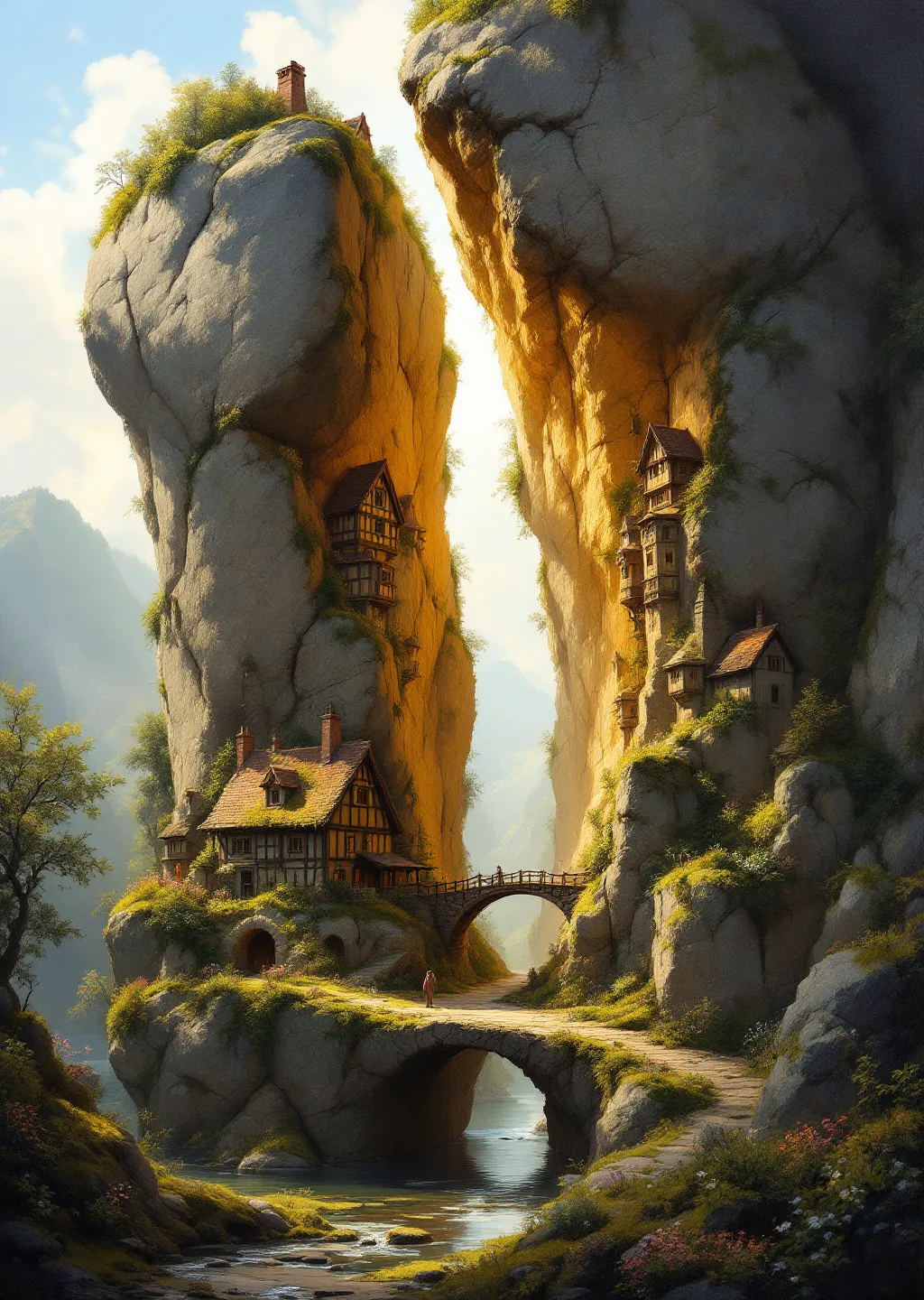
Splitrock
One boulder, two halves, and a village that never once settled the argument.
At a glance
- Kingdom XXXI (The Compound Fracture)
Some villages are named for a founder, some for a river, some for a saint nobody remembers. Splitrock is named for the geological fact it refuses to stop arguing with. The whole settlement is built into a single enormous boulder that, at some point long before anyone thought to write it down, cracked clean along its own fault line and became two halves of one stone — and the village has been living inside that disagreement ever since, one weathered side warmer and one colder, one better-lit and one worse.
You feel the split before you understand it. The gentler side of the boulder — the half that catches the morning sun and the day's kindness — is where life gathers. That's where the schoolhouse is, and where you'll find Iolanthe, known to everyone here as Miss Wren, teaching six children the shapes of letters with the patient repetition of someone who has taught this exact lesson a great many times and never once let it get stale. She writes in a hand worn soft by a long correspondence — loops that have clearly answered a blacksmith's letters, three kingdoms east, for years. The village doesn't ask whose letters. The village, in the way of small places built into stubborn stone, mostly minds its own fault line.
The other half is the one the local jokes are about. Chalk and chisel have made Splitrock into an accidental museum of its own condition. Carved into the boulder's fault line — put there by whoever finally settled the village's oldest structural debate — is a riddle: I am what a single stone becomes the moment it insists on being two arguments instead of one. The answer, of course, is splintered, which is the village's entire founding condition, still politely disagreeing with itself every single morning. On the boulder's better-lit half a resident with a taste for the last word has chalked up a companion complaint — this one aimed across the fault line, at the promises made on the worse-lit side of the stone, locally famous (it insists) for turning out sundered. Going by the state of most local promises, it isn't wrong. That is Splitrock's sense of humor: split, splintered, sundered, all three carved into the very thing the village can't stop being.
It would be a lonely joke if the place weren't so plainly working. The schoolhouse runs. The lesson gets taught, and will get taught again tomorrow, unbothered. Miss Wren keeps her name and her letters and her six children, and if she asks a passing traveler — carefully, the way you ask a thing you've asked few people — whether they're headed back toward the Broken Compound, the question isn't really about directions. Some things, her tone suggests, are better carried by the people who wrote them in the first place. You can offer to carry a word for her or leave the letters to the two of them; either way, the village closes gently behind you.
Splitrock isn't on the road to anywhere in particular. It's the quiet end of a longer argument that plays out at the Broken Compound, where Aldwyn turns a forged die over in his hands under a lamp, and at Compound Gate, whose two doors are built to open and close together, always, and have three times in living memory refused. In a kingdom obsessed with things that come in pairs — dies and their marks, doors and their twins, a blacksmith and the hand that answers him — Splitrock is the pair that decided, long ago, to simply keep living as two. It's the most honest address in the Compound Fracture. It never pretended to be whole.
Where you'll find it
Splitrock sits a short walk out from the Broken Compound, in the heart of Kingdom XXXI (The Compound Fracture) — reached by leaving the dispute hall and following the letters, quite literally, in the hand of a woman who has answered them for years. You come here in the back half of the kingdom, once the argument over a certain stamping die has run its course. Look for the great fractured boulder the village is built into; the schoolhouse is on its gentler, better-lit side, and you'll know it by the sound of six children learning their letters out loud.