
Every daily puzzle game has them: the days when the streaks die. Players ask us all the time which Pairdle was the hardest, and until now we only had stories. So we pulled the actual numbers: player results for each puzzle and each difficulty tier, added up. Then we ranked every puzzle by the share of players who solved it. (We later did the same ranking for Wordle's own worst words, if you want the other side of the comparison.)
Then we went back to each of those days' letter-pair pools to work out why they were so hard. Almost every time, the answer was not an obscure word. It was something sneakier.
A dated note, September 2026: this ranking covers Pairdle 1.0, the boards played between March and May 2026. The September 2026 update, Pairdle 1.5, changed the board to one row of boxes and 12 tiles cut from four real words, with three levels: Pairdle, Pro and Expert.
How we measured (and the honest caveats)
The ranking comes from our puzzle statistics. For each date and difficulty tier we stored how many players finished, how many won, and the average number of guesses. Two caveats to keep in mind while reading:
- The window is March 12 through June 16, 2026, the stretch our stats pipeline covered. Puzzles outside that window aren't ranked.
- The samples are modest. We left out puzzles with too few finishers so that one unlucky player couldn't swing the ranking. These are real results from real players, but treat the exact order as a snapshot, not a verdict.
You'll also notice the list is mostly Challenge and Championship boards. Pairdle 1.0 had three difficulty tiers each day: Standard, Challenge and Championship. The two harder tiers were built to be harder, and Championship gave you one slot per position and no mistakes. The rest is just what the data says. The Standard daily's worst day (UPDATE, April 30, 73%) didn't make the top ten.
A 15-second refresher on the old rules
In Pairdle 1.0, an answer was a six-letter word broken into three letter pairs: a FIRST pair, a MID pair and a LAST pair. You picked pairs from a pool built from eight hidden words (24 pairs; the Challenge tier stirred in 12 bonus pairs for 36). The trap was that the pool didn't only hold the answer's pairs. It held enough material to spell lots of real words. Each guess gave you feedback, and your job was to find the one word the puzzle meant. Today's board is smaller: 12 tiles from four real words.
Keep that in mind. How many other real words hid in the pool turns out to explain almost every entry below.
The ten hardest, counted down
10. CRYING, Championship, March 27 (67% solved, 2.8 avg guesses). The pool that day could spell 30 other valid words, the most of any puzzle on this list. They included WICKED, POCKET, LAYING and the one that did the damage: SPYING, which shares both the YI middle and the NG ending with the answer. With two -YING words in the same no-mistakes pool, a lot of streaks ended that day.
9. MUZZLE, Challenge, May 3 (67%, 3.9). ZZ was one of the strangest MID pairs in the game, and players didn't want to commit to it. The pool pushed them elsewhere with RUBBER, ROBBER and even ROZZER as spellable options. That's three doubled-letter fakes for one doubled-letter answer.
8. CORRAL, Championship, April 7 (63%, 3.0). The smallest trap pool on the list (12 other words), but a hard shape. CO was the second most common FIRST pair in the whole game, so it pointed everywhere at once. The answer's doubled RR and its plain -AL ending had to beat the louder -ER and -RY pairs sitting in the pool. The 3.0-guess average tells the story: players either saw it or went down swinging.
7. EVOKED, Challenge, May 2 (63%, 3.6). The reverse problem. EV was a rare FIRST pair (159th of 285), so nobody wanted to start there. Meanwhile the pool showed VE everywhere. VERSED, VERBAL and others were all spellable, pulling players toward V-words built the usual way around.
6. PUPILS, Championship, May 28 (63%, 4.2). A plain word with a plain -LS ending, in a pool full of louder options: TENDER, PUTTER and PURELY were all right there. Nothing about PU-PI-LS is rare on its own. Every slot just had a more inviting wrong answer.
5. BADASS, Championship, May 8 (63%, 4.4). Yes, really, that was the answer. The -SS ending was one of the rarest in the game (87th of 293 LAST pairs), and the pool offered a cluster of respectable-looking traps (OPENED, OPENER, OPINED) for players who ran back to familiar ground. The 4.4-guess average is tied for the worst grind on the list.
4. REFUTE, Championship, May 5 (63%, 4.4). The cruelest opening on the list. RE was the single most common FIRST pair in Pairdle, so finding it told you almost nothing, since hundreds of words start there. The real wall was the middle: FU ranked 262nd of 508 MID pairs. Players locked RE early and then wandered the desert, which is how this one cost 4.4 guesses on average.
3. CARVED, Challenge, March 13 (62%, 3.4). Here the players did everything right and still lost guesses. CA and RV came quickly, and then the pool offered CARVES, CARVER and CARVEL alongside CARVED. Two of the three pairs confirmed, four valid endings. In a tier where bonus pairs muddied the water further, that was a coin flip on top of a coin flip.
2. MEADOW, Challenge, May 8 (60%, 3.2). Our favorite trap in the whole dataset. The -OW ending was rare (70th of 293), so spotting OW should have cracked the puzzle. But this pool could also spell MELLOW, SHADOW and TALLOW. That's four -OW words in one pool, two of them starting with ME. The rare pair that usually rescues you was the trap that day.
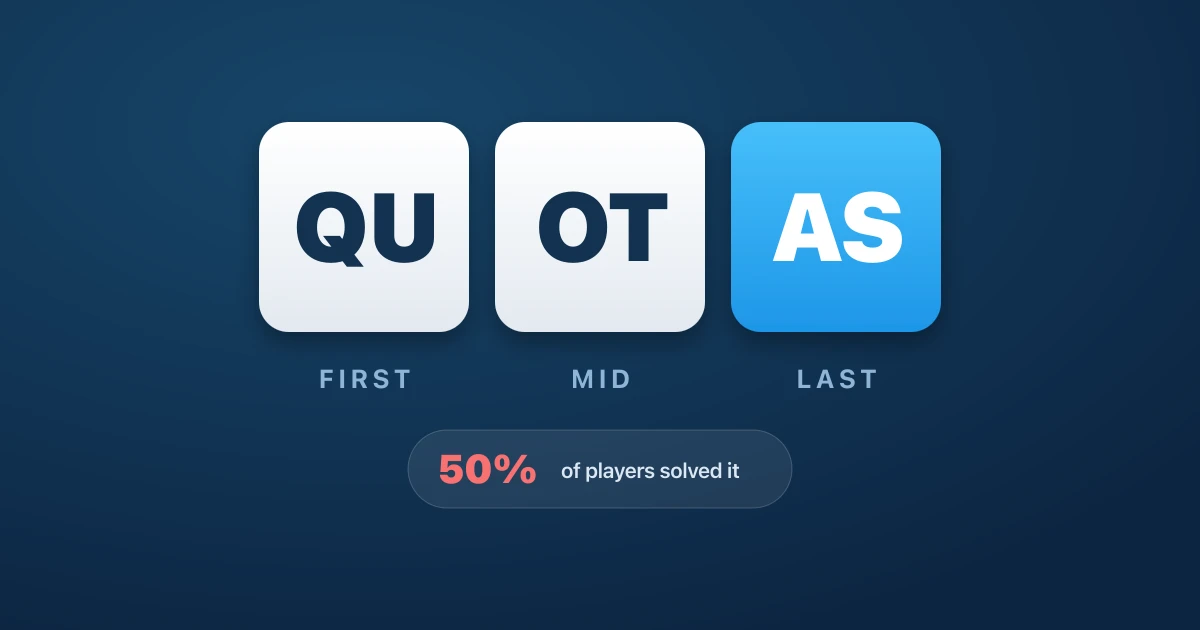
1. QUOTAS, Championship, May 25 (50% solved, 3.8 avg guesses). The only puzzle in the window that beat half its players. On paper it looked easy. There was a QU in the pool, and QU means a Q-word, so that should have settled it. But the pool also spelled QUOTED and QUILLS: three real QU- words in one no-mistakes tier. Worse, the real ending -AS had to beat -ED, the most common LAST pair in the entire game, which was sitting right there turning QUOT- into QUOTED. Half the field took the bait or ran out of guesses.
So what actually makes a Pairdle hard?
Put all ten side by side and a pattern shows up. It is mostly not about vocabulary.
- Lots of traps. Every pool on this list could spell between 12 and 30 other valid words. The puzzle wasn't "find a word." It was "throw out the fakes."
- Lookalikes that share pairs. The worst days put the answer next to a word that shared real pairs with it: SPYING against CRYING, QUOTED against QUOTAS, MELLOW against MEADOW. Feedback that confirms a pair can still lead you toward the wrong word.
- A rare pair where a common one fits. When the 262nd-ranked FU was the truth but a top-10 pair spelled something that looked right, the odds did the damage for you.
- Common pairs that point everywhere. RE and CO were the two most common FIRST pairs in the game. Finding one felt like progress and narrowed almost nothing.
- The old Championship rule. Pairdle 1.0's Championship tier gave you one slot per position and no mistakes, so every trap above got sharper when you couldn't afford to test it. That tier is gone in 1.5.
The lesson from the lookalike days still holds on today's board. In Pairdle 1.5 you get one row of boxes, 12 tiles from four real words, and six guesses. A BLUE tile is the right pair in the right box. RED means the pair is in the answer but in the wrong box. GREY means it is not in the answer at all. A BLUE pair tells you that box is right, not that the word you built around it is right. Pro is free now, and Practice gives you extra boards to play.
To get ready for the next streak-killer, start with our guide to getting better at Pairdle and the reference on common letter pairs in English. Then come get your rematch at today's puzzle. May your QU- always be QUOTAS.
By Tim Nye, founder of Logic Loft Games. The stats above come from Pairdle's puzzle results (March 12 to June 16, 2026, with a minimum number of finishers per puzzle); the trap analysis comes from re-running each day's actual letter-pair pool against Pairdle's own dictionary. No numbers were harmed or invented in the making of this article.
Related articles
Pairdle Hunt: How to Play and the Math of Hidden Words
Pairdle Hunt is Logic Loft's new word-hunt game, coming soon to iOS and Android. How to play, how scoring works, and how many words hide in one grid.
How to Master Pairdle, Column by Column
I counted the letter pairs in every answer on the Pairdle 1.5 schedule. The three boxes are nothing alike, and the last one is by far the easiest to call.
How Anagrams Work: Which Words Have the Most Anagrams
We sorted 172,823 legal words into anagram families. SPEAR has 11 partners, 44% of five-letter words have one, and nine common letters do most of the work.