
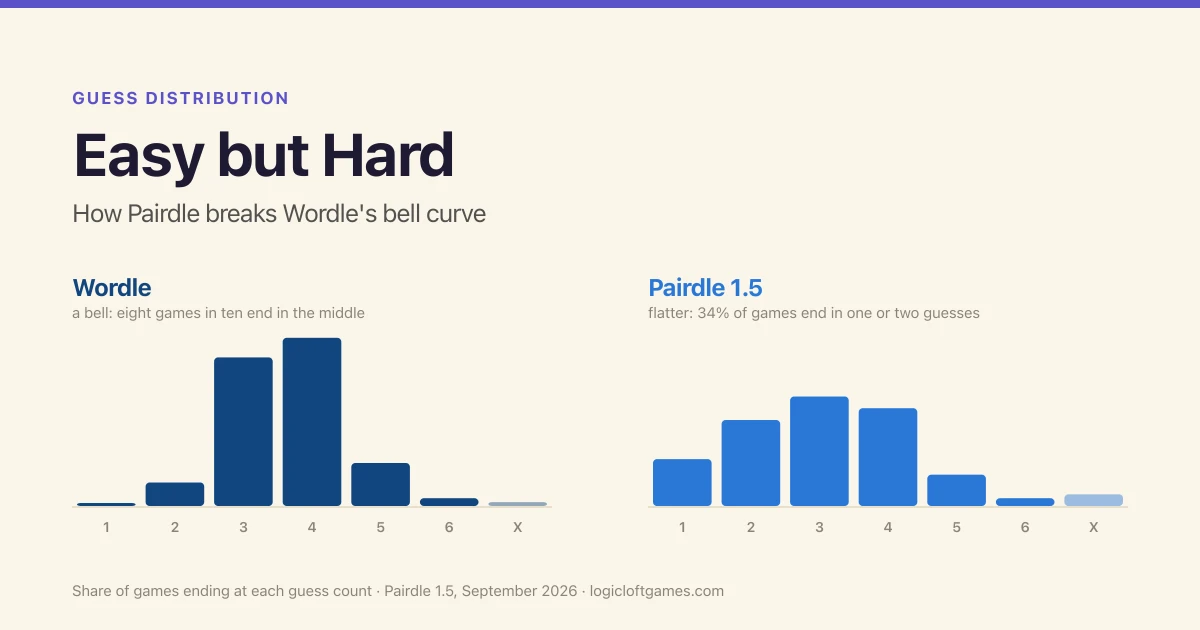
Every daily word game ends one of seven ways. You solve it in one, two, three, four, five or six guesses, or you don't solve it. That is the whole list of outcomes, so you can describe a game's difficulty and its feel with seven numbers.
Wordle's seven numbers make a bell. Almost everybody lands in the middle.
Pairdle's don't. When we sat down with our own player data, the shape that came back was stranger than we expected: on the Pairdle 1.0 board, players won faster than in Wordle on average, and lost about five times as often. The one-row Pairdle 1.5 board keeps the same split. It wins even sooner, and it still loses three times as often as Wordle.
That combination shouldn't be possible if "difficulty" is one number. It is possible if difficulty has a shape.
Updated 24 September 2026. Pairdle 1.5 went live on 11 September 2026 and put every level on one row. The section "Pairdle 1.5: the one-row board", further down, has its numbers. The first four sections and the first three charts are Pairdle 1.0 data, from the three-tier game that ran until September 2026.
The four shapes
Until September 2026, Pairdle shipped three daily tiers: Standard, Challenge and Championship. So the 1.0 data gives a four-way comparison, one Wordle against three Pairdles.
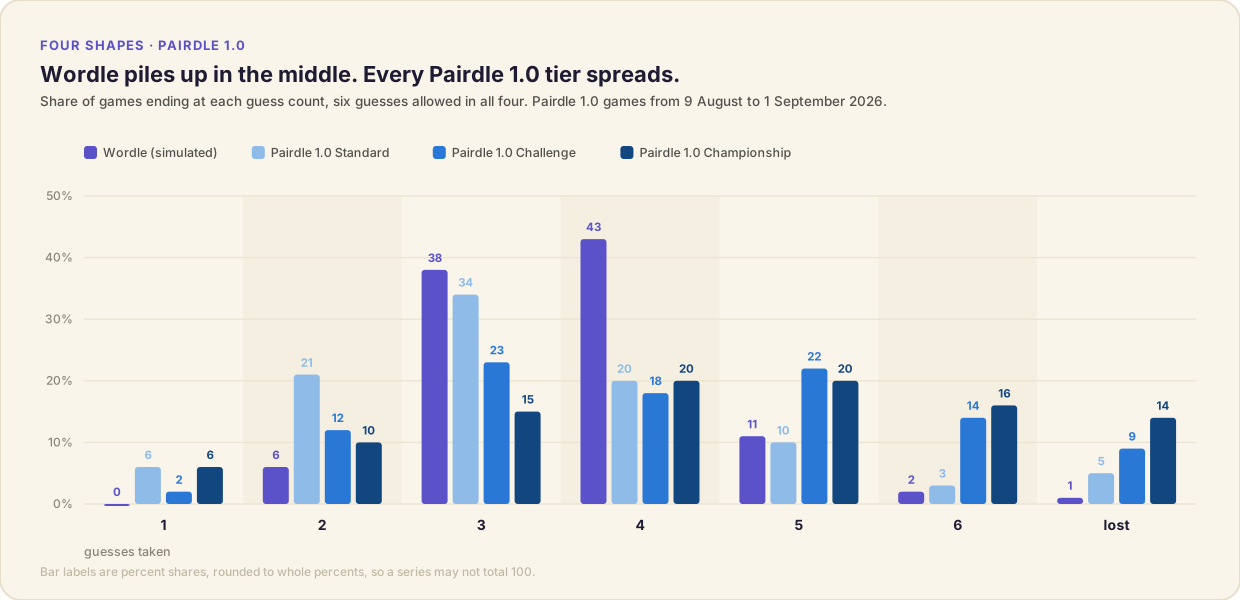
Look at Wordle first. Two bars carry the whole game: 38% of games end on guess three, 43% on guess four. Eight games in ten finish in that two-guess window. Almost nobody wins early. 6% get there in two, and winning in one is a lottery ticket. Almost nobody loses, either.
That is a bell, and a narrow one. In Wordle everyone gets pushed to the same place, a little faster or a little slower.
Now read the Pairdle 1.0 tiers left to right and watch the bars move. Standard's peak is lower than Wordle's and sits a guess earlier. Challenge's peak is lower again, and its right side is thicker. Championship barely has a peak at all.
Here are all seven numbers for all four, side by side:
| Games ending on… | 1 | 2 | 3 | 4 | 5 | 6 | lost |
|---|---|---|---|---|---|---|---|
| Wordle | 0% | 6% | 38% | 43% | 11% | 2% | 1% |
| Pairdle 1.0 Standard | 6% | 21% | 34% | 20% | 10% | 3% | 5% |
| Pairdle 1.0 Challenge | 2% | 12% | 23% | 18% | 22% | 14% | 9% |
| Pairdle 1.0 Championship | 6% | 10% | 15% | 20% | 20% | 16% | 14% |
(Whole percents, so a row may not total exactly 100.)
The simplest way to read that table is to find each row's biggest number, the single most likely thing to happen to you:
Wordle 43%. Standard 34%. Challenge 23%. Championship 20%.
In Wordle, nearly half of all games end the same way. By Pairdle 1.0 Championship, the most common outcome happens one time in five, and every one of the seven endings happens at least 6% of the time. There is no typical Championship game.
Wordle's two biggest buckets, guesses three and four, hold 81% of all games. Standard's two biggest hold 55%, and they are guesses two and three, so the peak is both lower and further left. Challenge's two biggest are guesses three and five, which means the distribution has split in half. Wordle piles its games up in one place. The three Pairdle 1.0 tiers spread them out, and spread them more as the tier gets harder.
The number that gives it away
Here are the averages, on the same six-guess budget:
| Average guesses to win | Games lost | |
|---|---|---|
| Wordle | 3.6 | 1% |
| Pairdle 1.0 Standard | 3.2 | 5% |
| Pairdle 1.0 Challenge | 3.9 | 9% |
| Pairdle 1.0 Championship | 4.0 | 14% |
Read the first two rows twice. Pairdle 1.0's daily was faster on average than Wordle and lost five times as often. The average says "easier." The loss column says "harder." Both are true, and for the same reason.
The last two rows show the same thing again. Challenge and Championship are a tenth of a guess apart on average, 3.9 and 4.0, close enough to call a tie. Championship loses half again as many games. Rank those two tiers by average and you would call them equally hard. Anyone who played both would laugh at you.
An average is a poor summary of a game. It tells you where the middle is, and the middle is the part of a daily puzzle nobody remembers. What you remember is the day it fell out in two, and the day your streak died.
Wordle rarely gives you either of those days. Pairdle gives you both.
Why Pairdle splits
It comes down to the board.
In Wordle, the answer is hidden among thousands of five-letter words and you buy information one guess at a time. The feedback is fine-grained, five letters with three colours each, so almost every guess narrows the field. You can't shortcut it, and you can't really get lost in it. That's why the bell is narrow: the game does the same thing to everybody.
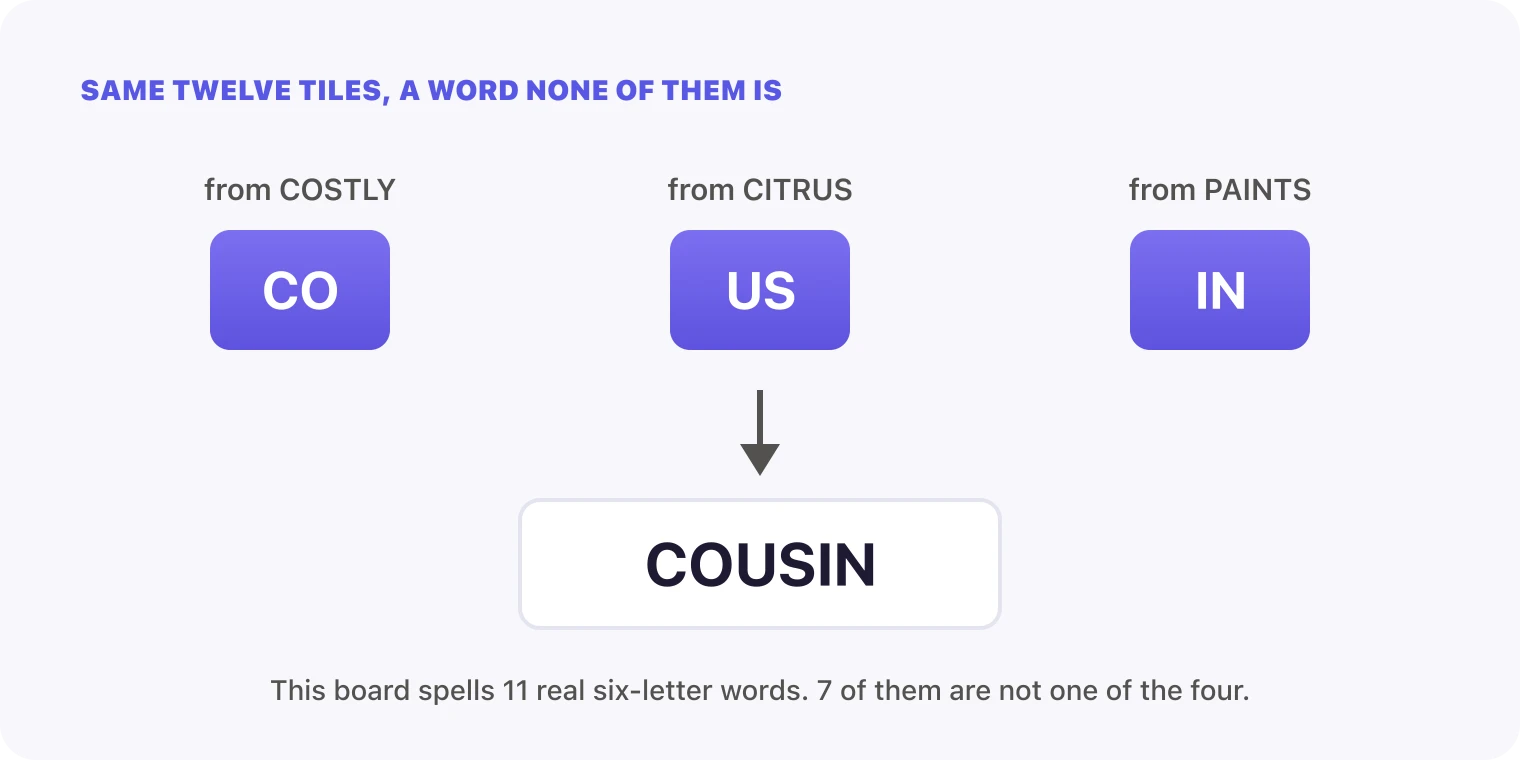
A Pairdle answer is a six-letter word cut into three letter pairs: a FIRST pair, a MID pair and a LAST pair. Those pairs come from a pool of tiles sitting face-up on the board. On the Pairdle 1.0 board the pool was 24 tiles, cut from eight hidden six-letter words. The 1.5 board uses 12 tiles from four words. Either way, every tile is visible from the first second.
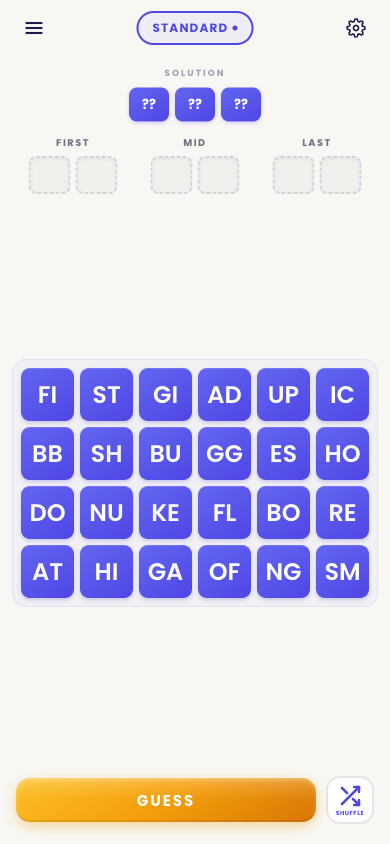
That visibility is the fast half. The answer isn't hidden in the dictionary. It's in plain sight among the tiles. Some mornings you look at the pool and the word is just there: you see GA, RD, EN and you're done before you've really started. Nothing in Wordle can do that, which is why Wordle's one-and-two-guess bars are nearly flat and ours aren't.
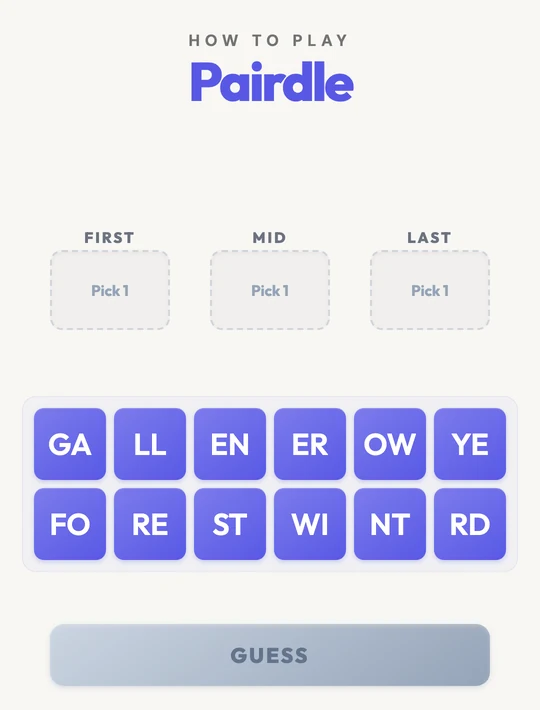
The slow half is what happens when you don't see it. The pool doesn't only hold the answer's pairs. It holds enough pieces to spell other real six-letter words, because it was built from several of them. And Pairdle's feedback is coarser than Wordle's: you get a colour on three boxes, not on five letters. So when you don't spot the word, you're left choosing between several real candidates with less information per guess than Wordle gives you. That's how a six-guess budget runs out.
You either spot the word or you grind it out. That is why the distribution has two humps.
The one-guess column shows this on its own, with one caveat. Our Wordle simulation opens with the same word every day, so it wins on guess one only when the answer happens to be that exact word. The 0% is partly a side effect of the method, and real players who change their opener do sometimes get lucky. But only sometimes. In Wordle, a one-guess win is nothing but luck. No skill produces it, because you are naming one word out of thousands with no information at all.
In Pairdle 1.0 Standard it's 6%, which is far too often to be luck. Those players looked at the pool and recognised the word before making a single guess. Wordle has no move like that, because at guess one there is nothing to look at yet.
The other side is the loss column, and a Pairdle loss is a different kind of loss. Losing at Wordle usually means you got stuck in a word family: you narrowed it to _ATCH and burned your last guesses on CATCH, MATCH, LATCH. Losing at Pairdle usually means the opposite. You had too many plausible candidates rather than too many similar ones, and three boxes of feedback per guess wasn't enough to separate them before the budget ran out. In Wordle you keep losing a coin flip. In Pairdle you run out of guesses before the search is done.
This is also why the hardest Pairdle days are hard. When we ranked our ten most brutal puzzles, the cause was almost never an obscure answer. It was a pool that spelled too many good alternatives.
Difficulty stretches the curve, it doesn't slide it
If the two-hump story is right, a harder tier shouldn't just push the whole curve to the right. It should pull it apart at both ends. Stacked up as whole games, that's what the Pairdle 1.0 tiers do:
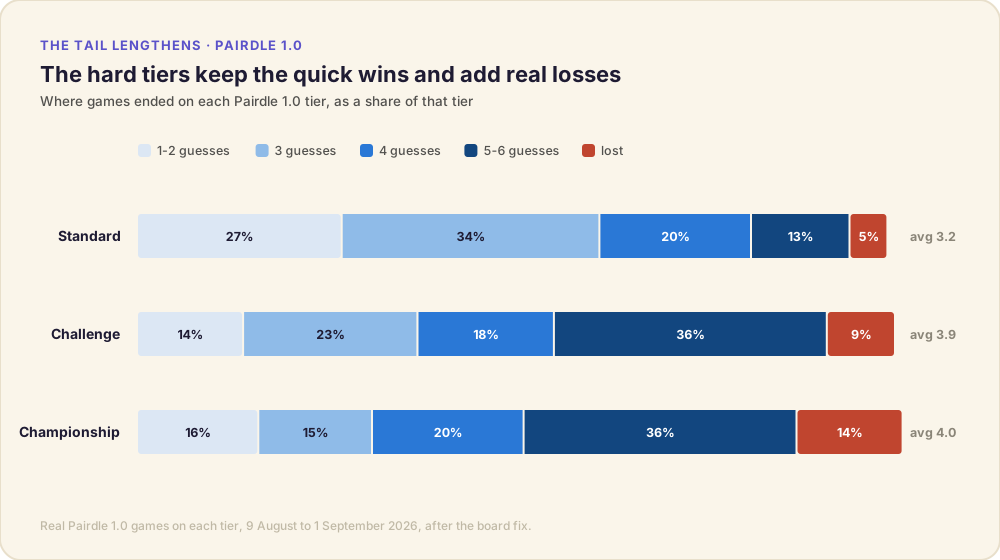
Championship is the clearest case. It gave you one box per position and no room for error, and it lost 14% of its games, fourteen times Wordle's loss rate. Half of all Championship games took five guesses, six guesses, or ended in failure.
And yet it still ended 16% of games in one or two guesses. That is more early finishes than Challenge, and nearly three times Wordle's share. The hardest thing we shipped was over in two moves more often than the easiest thing Wordle ships.
So the harder tiers did two things at once: more games ran long, and plenty still ended early.
If you cleared one of the old Championship boards, take the win seriously. Roughly one in seven of them beat players outright. That is fourteen times the loss rate of a well-played Wordle, which goes down about once in two hundred games. So if you finished one, that wasn't luck and it wasn't routine. You're a word wizard, and you may quote us on it.
Pairdle 1.5: the one-row board
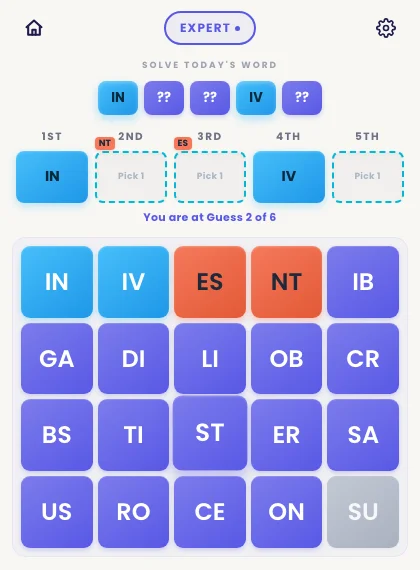
Pairdle 1.5 went live on 11 September 2026. It replaced the three tiers with three levels on one row each. Pairdle is a six-letter word in three boxes, with 12 tiles on the board. Pro is eight letters in four boxes. Expert is ten letters in five boxes, with 20 tiles. Every level still gives you six guesses, and the colours still mean the same thing: blue is the right pair in the right box, red is in the word but in the wrong box, grey is not in the word.
We counted games finished from 12 September, the first full day after the update, to 24 September 2026:
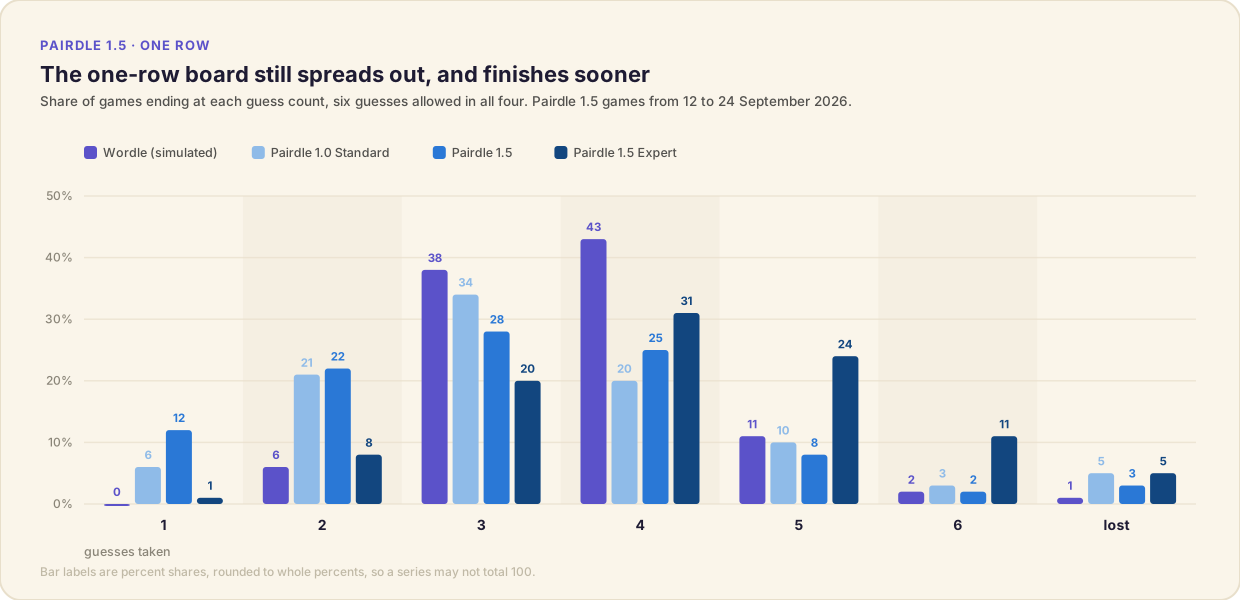
| Games ending on… | 1 | 2 | 3 | 4 | 5 | 6 | lost |
|---|---|---|---|---|---|---|---|
| Wordle | 0% | 6% | 38% | 43% | 11% | 2% | 1% |
| Pairdle 1.5 | 12% | 22% | 28% | 25% | 8% | 2% | 3% |
| Pairdle 1.5 Expert | 1% | 8% | 20% | 31% | 24% | 11% | 5% |
The Pairdle level is faster than the old Standard tier. One game in eight ends on the first guess, twice the 1.0 Standard share, and a third of all games end in one or two guesses. The average win takes 3.0 guesses, down from 3.2. Losses fell from 5% to 3%.
It is still not a bell. The biggest bar is 28%, well under Wordle's 43%, and the two biggest (guesses three and four) hold 53% of games against Wordle's 81%. The loss column is three times Wordle's. So the headline still holds on the new board: Pairdle wins sooner than Wordle and loses more often.
The difference is at the slow end. On 1.0 Standard, 18% of games went to five guesses, six, or a loss. On the one-row board it is 13%, about the same as Wordle's 14%. With 12 tiles instead of 24 there are fewer wrong words to try, so fewer games drag on.
Expert is where the long games went. Its peak is on guess four, like Wordle's, but lower at 31%, and 40% of Expert games take five guesses, six, or end in a loss. Only 9% end in one or two guesses, close to Wordle's 6%, because a ten-letter word in five boxes is much harder to spot in one look. The average Expert win takes just over four guesses. So in 1.5, the hardest level does something the 1.0 tiers didn't: it slides the curve to the right more than it stretches it.
These are the first two weeks of a new board, so treat them as an early reading. We will run the numbers again once 1.5 has a full month behind it. Pro is not in the chart yet: its saved results don't record which board a game was played on, so we can't separate one-row Pro games from older ones.
A methods note, including the embarrassing part
Two things you should know before you trust the charts.
The Wordle line is simulated. The New York Times doesn't publish a machine-readable guess distribution. The community numbers live inside WordleBot, behind a subscription, and its public data feed returns the day's answer and nothing else. So rather than reuse someone else's scrape, we ran our own: every answer in the real Wordle answer list, played with a fixed opener and a consistent strategy, six guesses allowed.
The check is whether it lands where real play lands. It does. The simulation averages 3.6 guesses and solves 99% of boards, which matches the community averages that third-party trackers report from WordleBot. The shape matches too. Wordle is a narrow enough game that decent play and average play give nearly the same curve, which is itself a fact about Wordle. That's why we are comfortable putting it next to human data.
Our Pairdle 1.0 data only counts from 8 August 2026, because before that our board was broken. Pairdle 1.0's generator was supposed to lay out 24 tiles from eight words: the answer plus seven decoys. A single bug meant it threw nearly all the decoys away and filled the gaps with meaningless letter pairs, so the board carried the answer's own three pairs and almost nothing else. It shipped in December and we didn't catch it until August.
That matters, because a board with no decoys is a much easier board:
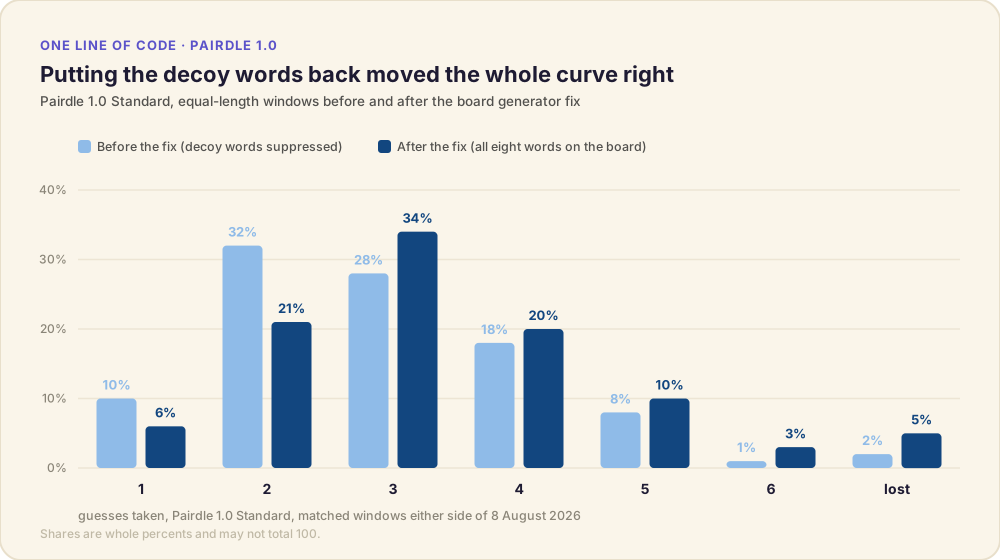
Before the fix, 42% of daily games ended in one or two guesses and 2% were lost. After it, that early share fell to 27% and losses more than doubled. The average moved from 2.9 to 3.2 guesses. One line of code, and the game got measurably harder. It finally played the way it was designed to.
We could have started the chart in August and said nothing. But a distribution is only as good as the boards that produced it, and half this article is about what decoy words do to a curve. This is that experiment, run by accident, on ourselves.
For Pairdle 1.5 we counted only games played on the one-row board. The web version still lets you switch back to the old board, archive days still use it, and some app players had not updated yet, so we used each game's saved guesses to tell the two boards apart and left the old-board games out.
Two smaller caveats. The samples behind our numbers are modest. They are real players, but treat the exact percentages as a snapshot rather than a verdict. And a new player's very first board is a gentle practice round that never reaches these statistics, so if anything the early-win share here understates what a new player sees.
What a shape is worth
There's a fair design argument that Wordle's bell is the right answer for a daily puzzle. It's dependable. Almost everyone succeeds, at roughly the same rate, and nobody's streak dies on a Tuesday for reasons they can't explain. When we looked at why five letters is the right length, that reliability was the main finding: five letters is where a word game gets real tension without regular heartbreak.
But dependable has a cost: very little is at stake on any one day. If eight games in ten end the same way, the ending isn't news.
We didn't set out to build a flat curve. We set out to build a game where the board is visible and you reason about words rather than letters, and a flat curve is what that produces. Pairdle asks something different of you than Wordle does. Some mornings it hands you the answer and you feel like a genius for eleven seconds. Some mornings it hands you six plausible words and one budget, and you lose.
If you want to know which kind of player you are, don't look at your average. Look at how much weight sits at the two ends of your seven numbers.
If you've only ever played one of the two, here's how the games differ, and Pairdle itself is free on the web, iOS and Android.
By Tim Nye, Logic Loft Games
Related articles
The Hardest Wordle Words on Record: Can You Solve Them?
We ranked 502 Wordle answers by the guesses they actually took, found the five worst, and built a five-round test so you can play them against the average.
Futbolle: Eighteen Daily Football Puzzles
A solo developer in Turkey built Futbolle, eighteen daily football puzzles — a Wordle whose dictionary is a squad list, a hidden starting XI — earning nothing.
Quest to 100 - My Attempt to Beat SLIDE
My best-ever Slide solve is 99 moves. My average is 222. The quest to break 100 starts with every tool in the bag — and today's Ice Cream board.