
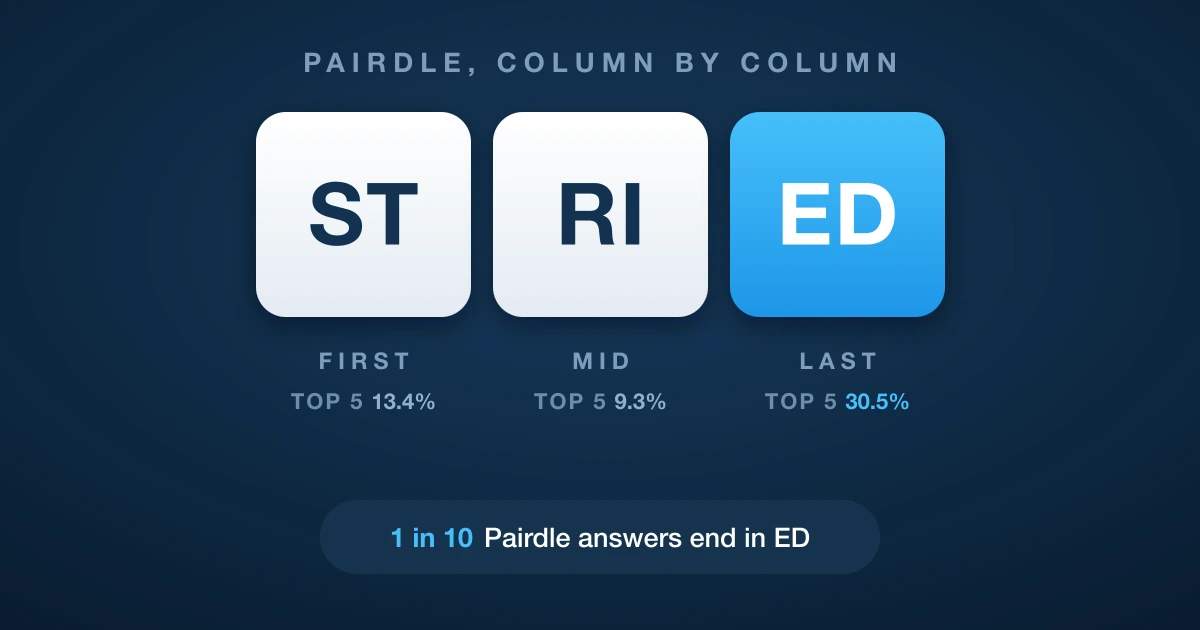
Most Pairdle advice treats the three boxes as three copies of the same problem. Look at the tiles, find a word, place your pairs. That's how I described it myself for a long time.
Then I counted, and the boxes turn out to be very different. One of them has a short list of favourites that covers nearly a third of all answers. Another spreads across two hundred and forty-five different pairs. Knowing which is which changes the order you should solve them in, and for most players it's the biggest single improvement on offer.
So here is every number, box by box, for Pairdle, Pairdle Pro and Pairdle Expert. Then the playbook I use.
How I measured, and the honest caveats
Pairdle 1.5 builds each day's board from four real words. Each word is cut into letter pairs, so a six-letter Pairdle word gives three tiles and the board holds 12. Pro uses eight-letter words and 16 tiles. Expert uses ten-letter words and 20 tiles. One of the four words is the answer. The other three are decoys. No pair is shared between two of the words, so every tile on the board is different.
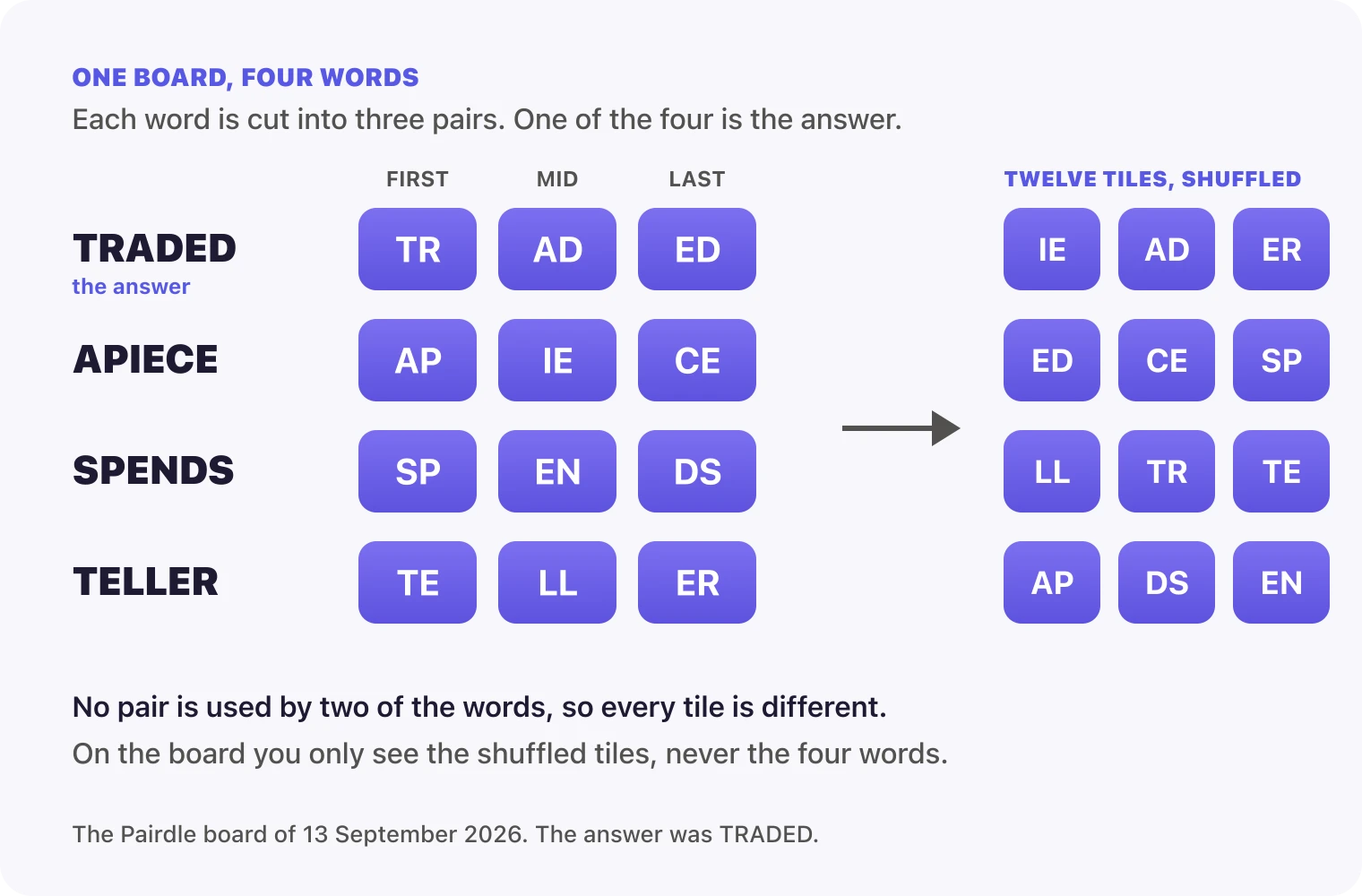
I took every board on the 1.5 schedule and cut each answer into its pairs. Letters one and two go in FIRST, three and four in MID, five and six in LAST. Then I counted how often each pair landed in each box. That is 1,124 Pairdle boards, running from October 2025 to November 2028. Pro has 1,082 boards and Expert has 1,124.
A note on what "every board on the schedule" means. The game works out each date's board from a fixed list, so I can replay the builder for every date, past and future. Boards before about 11 September 2026 were really played on the old Pairdle board, which picked a different answer. On 1,083 of those 1,124 dates the 1.5 answer is not the answer the old board used. So this is the answer set Pairdle has today, not a record of what people played last spring.
Four caveats to carry while reading.
I only counted answer pairs. Of the 12 tiles on a Pairdle board, three belong to the answer and nine are decoys. I counted nothing but the answer's pairs, because "what is most likely right in this box" is the question worth answering.
This is a big sample, not the whole game. The schedule uses 935 different Pairdle answers. Pairdle's word list holds 3,034 common six-letter words, and 934 of those 935 answers are on it (the other one has since been banned). So the answers cover about 31% of the list. The tables below tell you what the game actually asks. The "never" claims further down are checked against the whole list and a Scrabble dictionary as well as the answers, so they don't depend on the sample.
Some answers come round more than once. There are 1,124 boards and 935 answers, so 166 words appear more than once, none more than four times. I ran every number twice, once per board and once per distinct word, and in the top-20 lists the two never differed by a full percentage point. The tables are per board, which is what you meet.
A few answers repeat a pair of their own. BANANA needs two NA tiles, and REVERE and ICONIC do the same trick. Those three boards carry a doubled tile. Every other board has 12 different tiles.
Pairdle's LAST column: where the game is won
Start here.
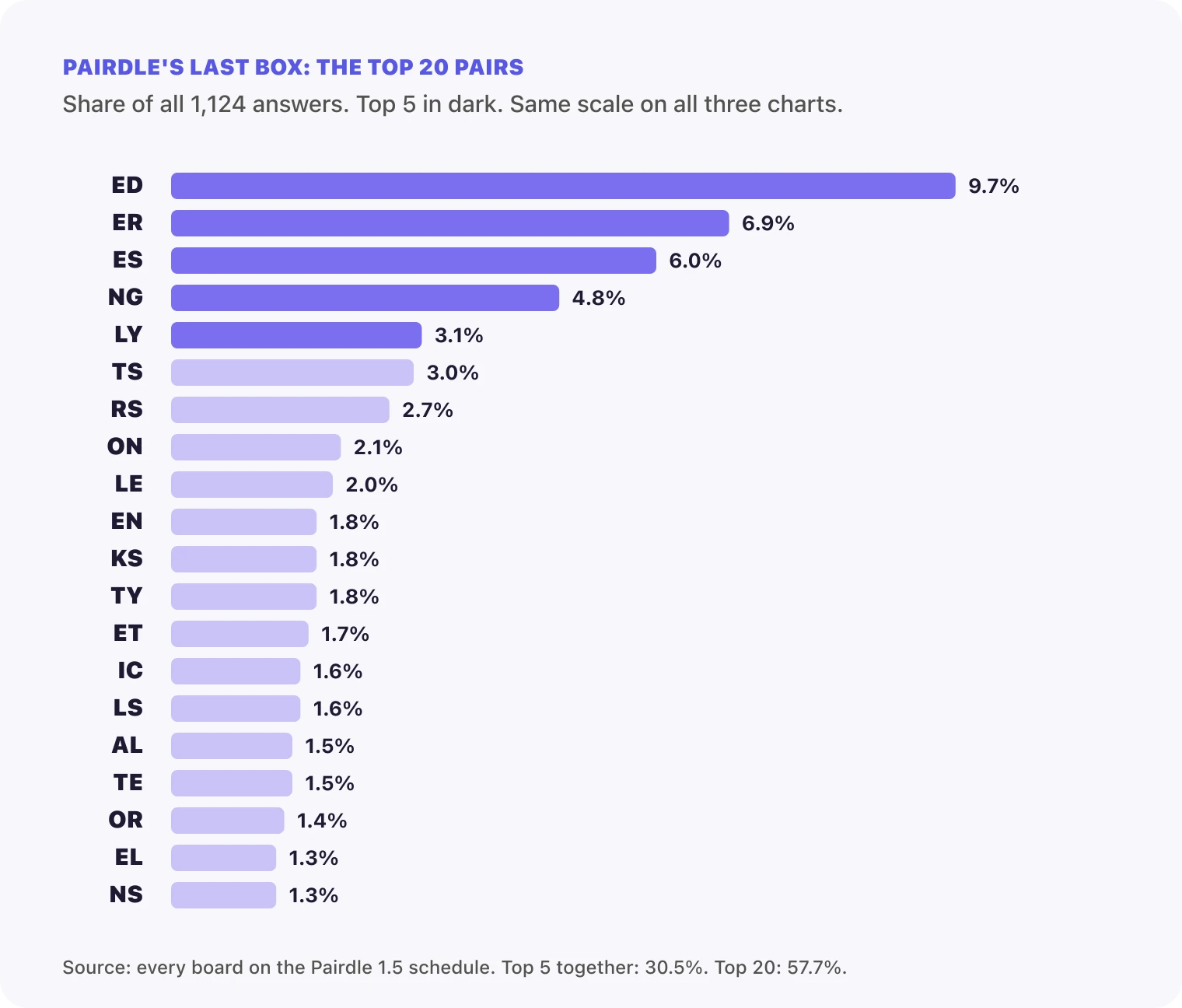
The top five LAST pairs cover 30.5% of every Pairdle answer on the schedule. Widen to the top twenty and you're at 57.7%. More than half of all Pairdle endings come from a list short enough to learn over one cup of coffee.
| Rank | Pair | Share of all LAST columns |
|---|---|---|
| 1 | ED | 9.7% |
| 2 | ER | 6.9% |
| 3 | ES | 6.0% |
| 4 | NG | 4.8% |
| 5 | LY | 3.1% |
The next fifteen, in order: TS 3.0%, RS 2.7%, ON 2.1%, LE 2.0%, EN 1.8%, KS 1.8%, TY 1.8%, ET 1.7%, IC 1.6%, LS 1.6%, AL 1.5%, TE 1.5%, OR 1.4%, EL 1.3%, NS 1.3%.
ED alone is about one answer in ten: 109 of the 1,124. If you remember one number from this article, make it that one.
The reason is grammar. English makes its past tense, its "someone who does it" nouns, its plurals and its -ing words by sticking the same few endings onto shorter words: -ed, -er, -es, -ing, -ly, -s. A six-letter word is long enough to be one of those forms, and short enough that the ending fills the whole last pair. TRADED, RUBBER, GLOBES, EASING, EASILY. The last box isn't testing your vocabulary much. It's testing whether you remember that English has about six ways to end a word.
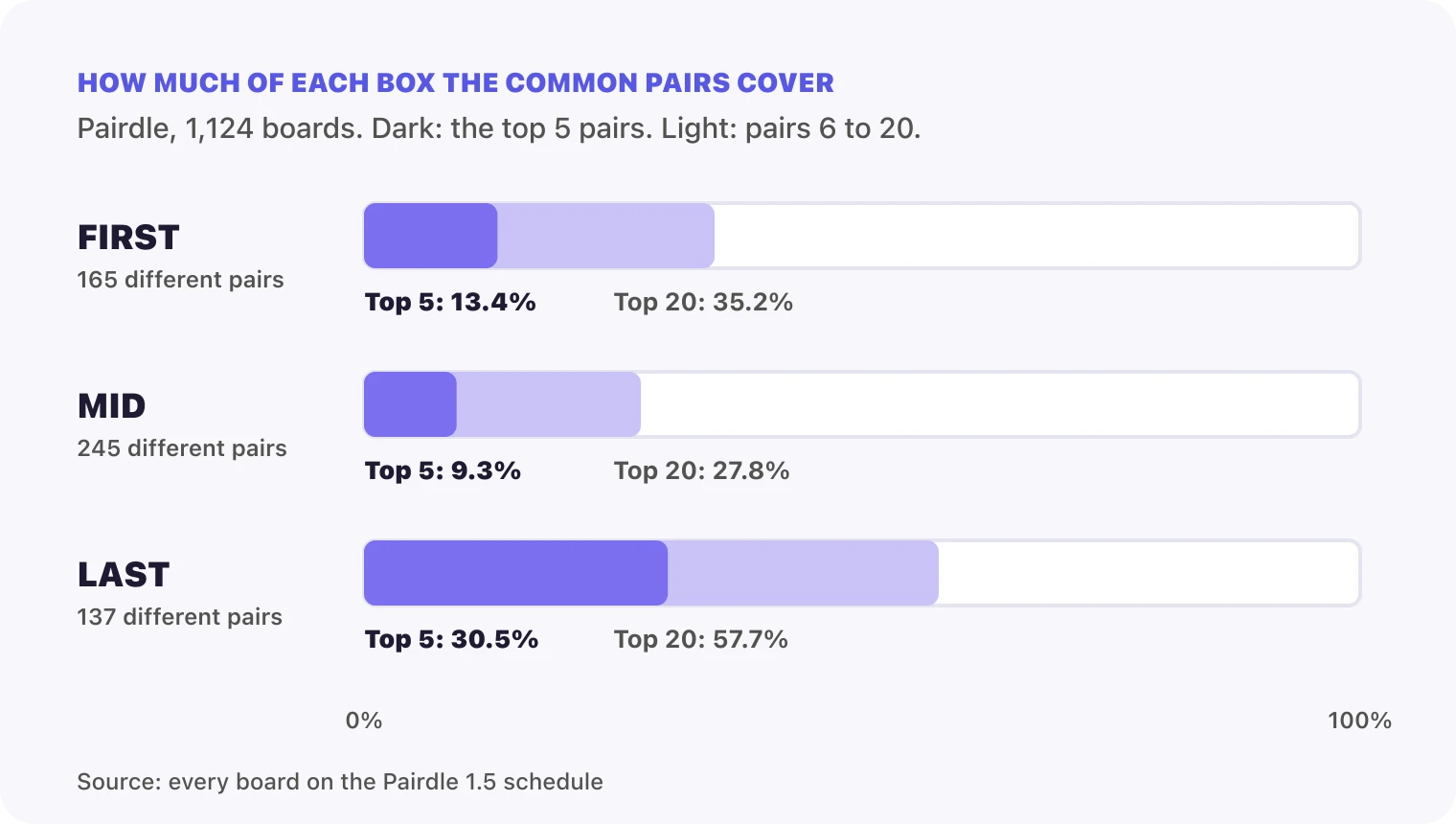
LAST is also the narrowest box. Only 137 different pairs appear there, against 165 in FIRST and 245 in MID. Fewer options, and the few that exist are heavily stacked at the top. It is the most predictable part of the board by a long way.
Pairdle's FIRST column: broad, but with favourites
FIRST sits in the middle. The top five take 13.4% and the top twenty take 35.2%. There's real signal, but nothing like LAST.
| Rank | Pair | Share of all FIRST columns |
|---|---|---|
| 1 | ST | 3.4% |
| 2 | RE | 2.9% |
| 3 | DE | 2.5% |
| 4 | CA | 2.3% |
| 5 | MA | 2.3% |
Then: CO 2.0%, GR 1.6%, LA 1.6%, PA 1.6%, SH 1.6%, CL 1.5%, SU 1.5%, SP 1.4%, HE 1.3%, MO 1.3%, TH 1.3%, BO 1.2%, CH 1.2%, WA 1.2%, AR 1.2%.
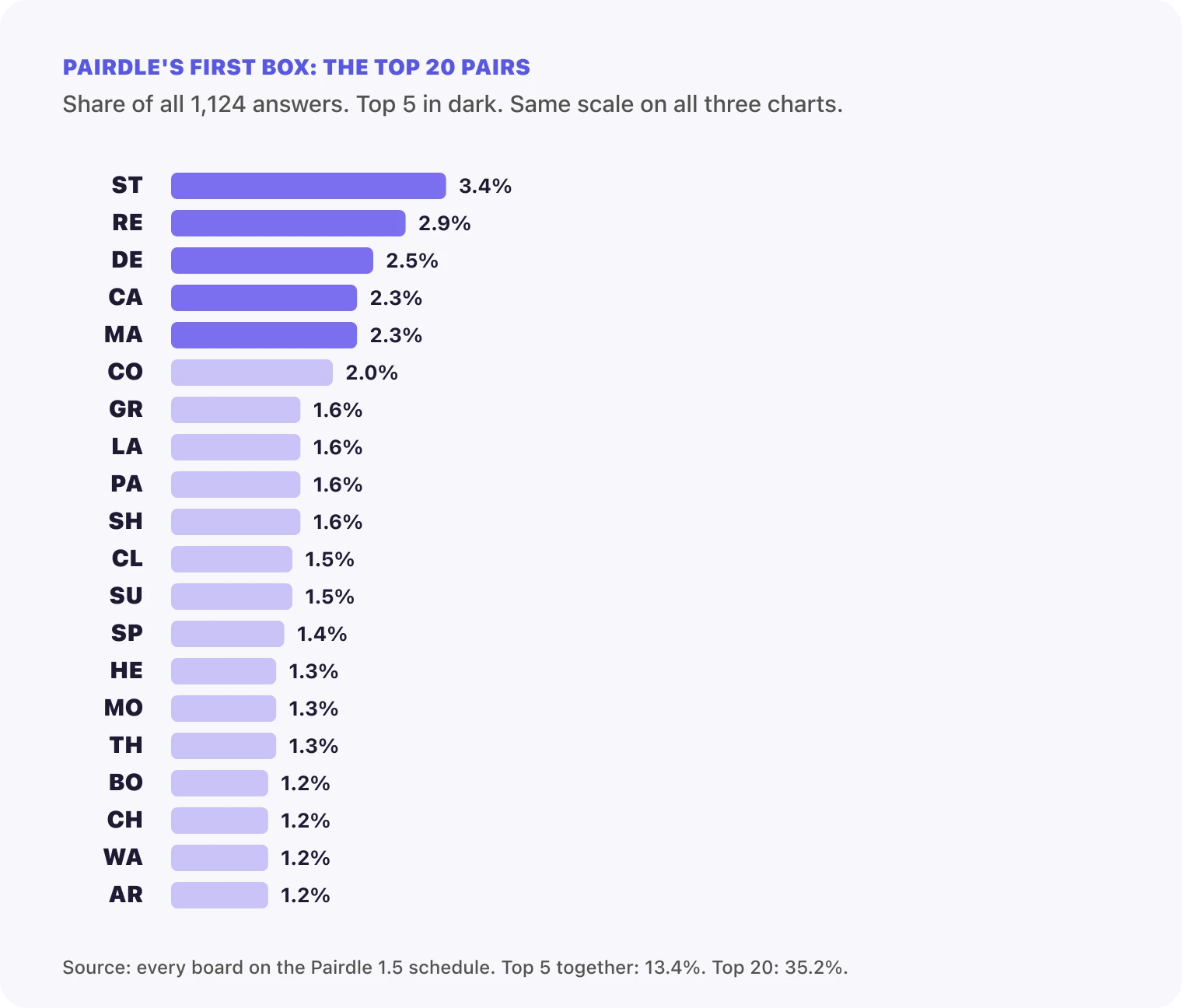
Two groups do most of the work here. There are the word starts that work like prefixes, RE, DE, CO, SU, as in REPEAT, DEFEAT, COMBAT and SUNSET. And there are the consonant pairs English is happy to open a word with: ST, GR, SH, CL, SP, TH, CH.
FIRST feels harder than LAST because the list is flat where it counts. ST at 3.4% is the most likely opening in the game, and it is still wrong about 97 times in 100. You can't guess your way into a first box. You can only narrow it down.
Pairdle's MID column: the one you should never guess into
MID is the flattest box in Pairdle. Top five: 9.3%. Top twenty: 27.8%. It holds 245 different pairs, far more than either neighbour.
| Rank | Pair | Share of all MID columns |
|---|---|---|
| 1 | RI | 2.2% |
| 2 | NI | 2.0% |
| 3 | EA | 1.8% |
| 4 | RO | 1.7% |
| 5 | CK | 1.6% |
Then: AR 1.4%, OR 1.4%, ST 1.4%, TI 1.4%, SI 1.3%, RE 1.2%, AN 1.2%, DI 1.2%, LL 1.2%, NN 1.2%, TA 1.2%, UN 1.2%, VE 1.2%, AT 1.1%, EE 1.1%.
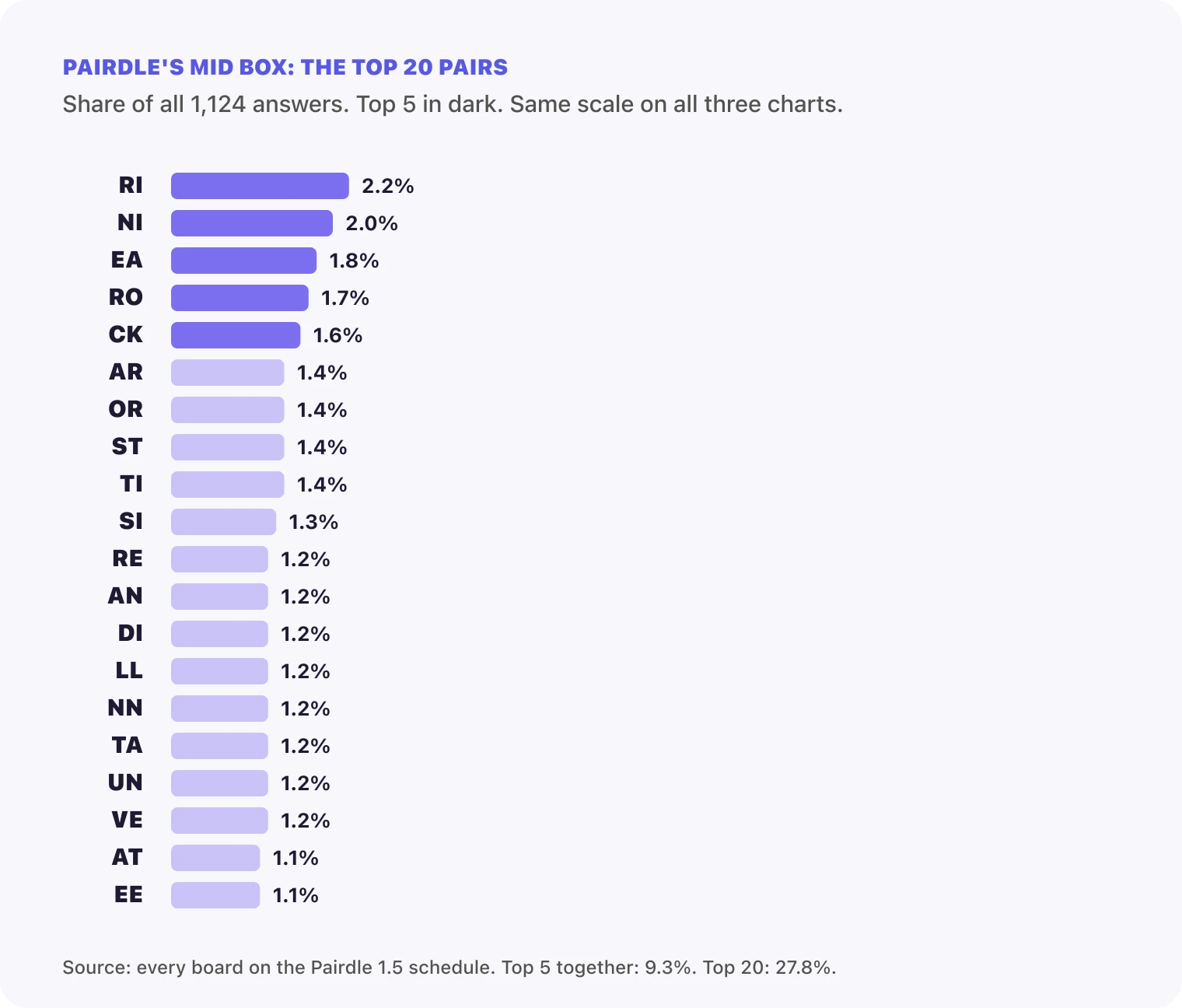
Look at the chart next to the LAST one. The bars barely get going. Nearly three quarters of all MID pairs come from outside the top twenty. The middle of a word is where English keeps its variety: the doubled letters (LL, NN, EE, CK), the vowel pairs, the bits of the root word that no ending ever touches. There's no grammar shortcut, because the middle of a word isn't doing grammar.
So MID should be the last box you commit to, and you should almost never guess it cold. Once FIRST and LAST are locked, the middle is often forced, because few real words fit TR _ _ ED with the tiles you have left. Guessing MID first and building outward means playing the hardest box first with the least to go on.
What never shows up where
A pair missing from 935 answers is not the same as a pair that can't appear, so I split the claims into two tiers and checked each one against the whole word list.
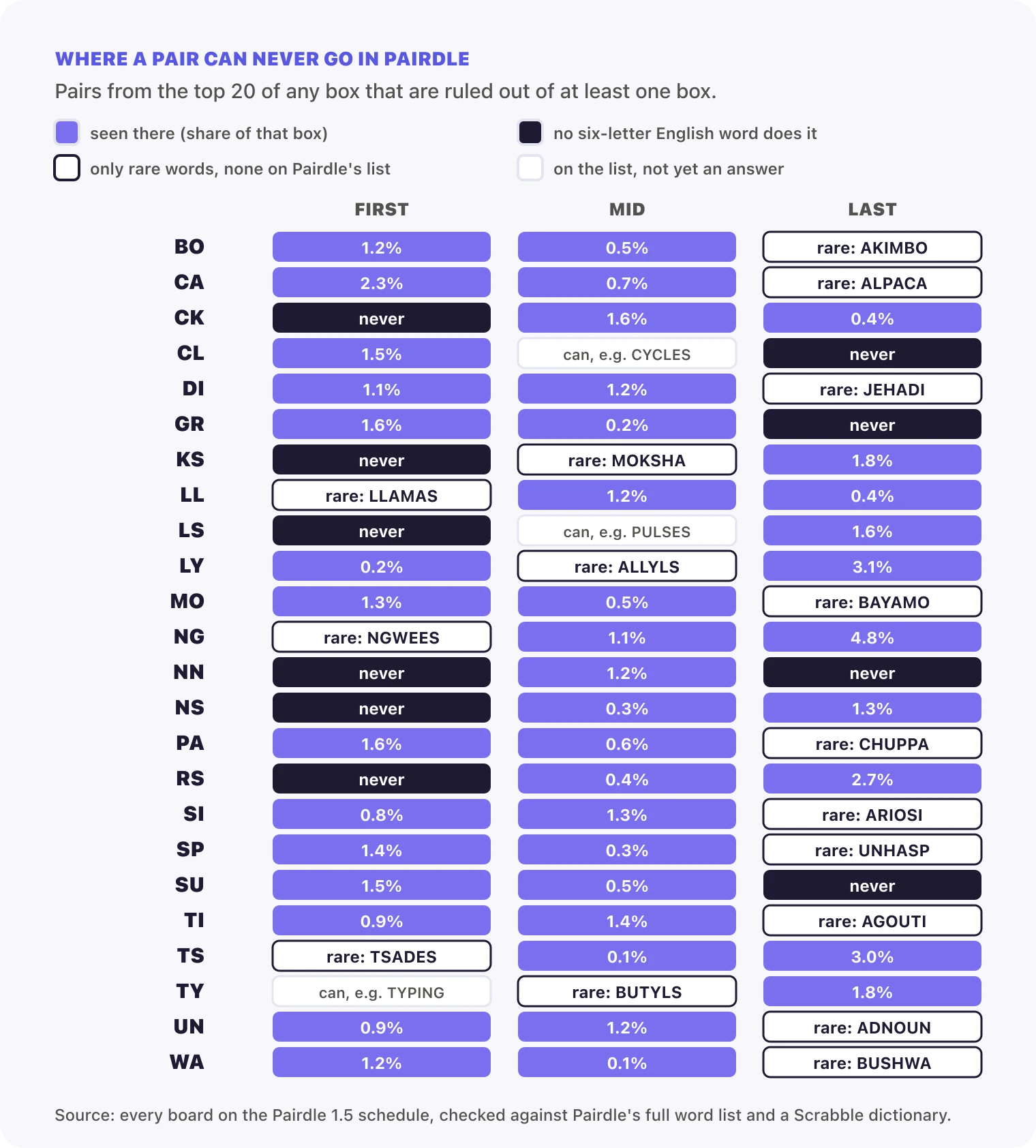
The first tier is impossible in English. No six-letter word in the dictionary puts these pairs here, common or rare:
- Never FIRST:
CK,KS,LS,NN,NS,RS. No English word starts with any of them. - Never LAST:
CL,GR,NN,SU. Nothing of this length ends that way.
If you see CK on your board, it is not your first box. Ever. That is a free elimination, and CK turns up often: it's the fifth most common MID pair in the game.
The second tier is impossible in Pairdle, but only because of the word list. These do exist in English, just not among the common words Pairdle uses. I'm naming the rare words so you can check me:
- Never FIRST:
LL,NG,TS. LLAMAS and TSETSE are real words, but they aren't on the list. - Never LAST:
BO,CA,DI,MO,PA,SI,SP,TI,UN,WA. AKIMBO, ALPACA and AGOUTI all end this way, and none of them are Pairdle words. - Never MID:
KS,LY,TY. The only six-letter words with these in the middle are things like MOKSHA and BUTYLS.
Notice what's missing from the first tier. Among these common pairs, English rules out none from MID. The only MID exclusions come from Pairdle's list, and there are three of them. It's the loose box in every sense: widest, flattest, and the one that rules out least.
Two pairs have exactly one possible home in Pairdle. KS can only be LAST (English rules out FIRST and the list rules out MID), and NN can only be MID. When either turns up, you know where it goes before you guess.
Pairdle Pro: same story, louder
Pro's eight-letter words give you four boxes, and the pattern gets stronger. Pro is free for everyone in 1.5, so all of this applies to you whether or not you've ever paid for anything.
| Column | Distinct pairs | Top 5 share | Top 20 share |
|---|---|---|---|
| FIRST | 154 | 15.1% | 37.4% |
| SECOND | 233 | 10.9% | 29.9% |
| THIRD | 203 | 14.2% | 35.8% |
| LAST | 110 | 35.4% | 67.7% |
Pro's final box is sharper than Pairdle's. The top five take 35.4%, the top twenty take 67.7%, and it draws on only 110 different pairs.
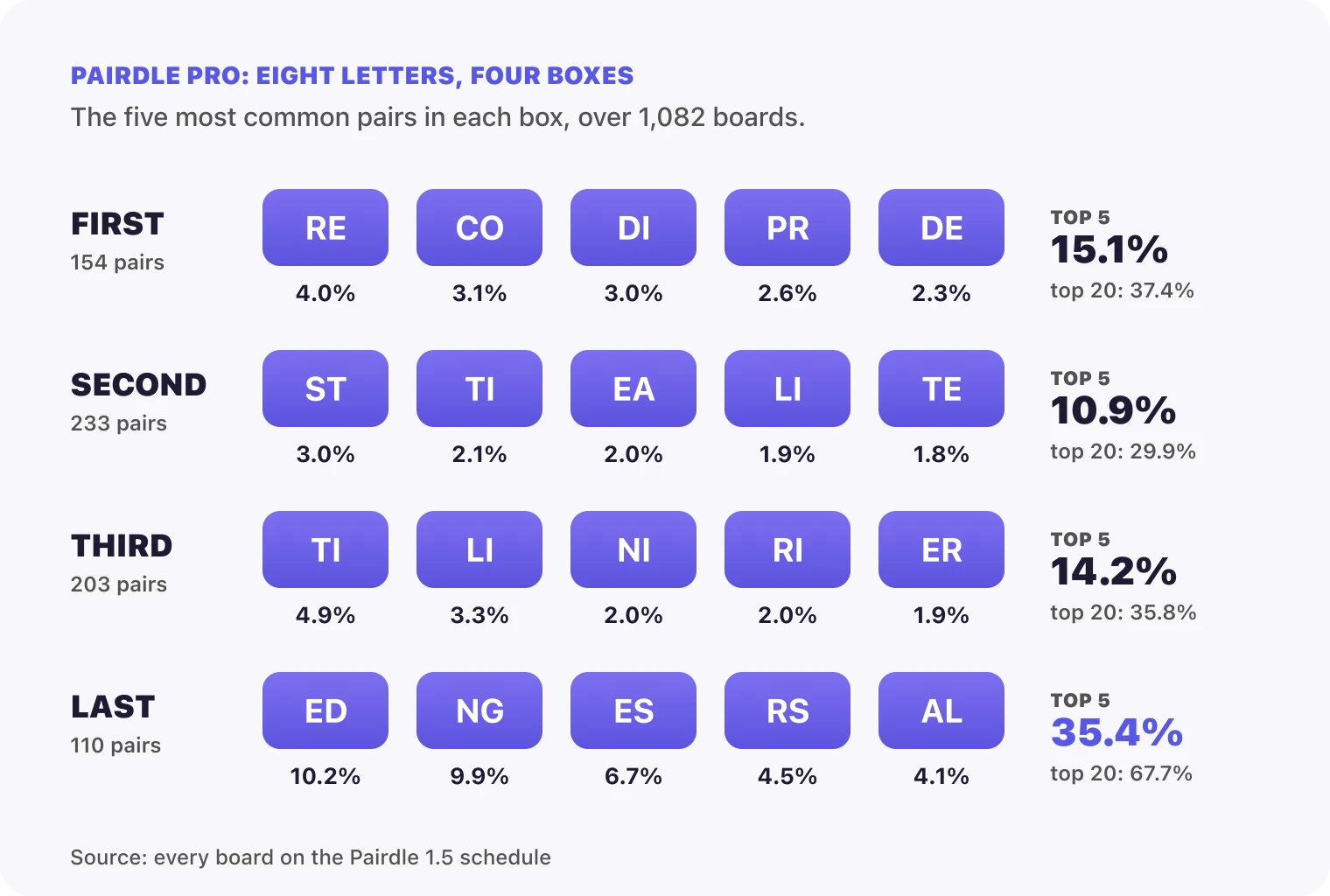
LAST: ED 10.2%, NG 9.9%, ES 6.7%, RS 4.5%, AL 4.1%. Then ER 3.0%, TS 3.0%, ON 2.7%, LY 2.6%, NT 2.3%, NS 2.1%, TE 2.1%, TY 2.0%, IC 1.9%, LE 1.9%, RY 1.9%, ST 1.9%, SE 1.8%, DS 1.4%, CE 1.3%.
ED and NG are almost level, and between them one Pro answer in five ends in one of two pairs. Eight-letter words are very often word forms built on shorter words, and -ing gets much more common as words get longer.
FIRST: RE 4.0%, CO 3.1%, DI 3.0%, PR 2.6%, DE 2.3%. Then IN 2.3%, ST 2.1%, MA 1.6%, BR 1.5%, CA 1.5%, CR 1.5%, EN 1.5%, PA 1.5%, TR 1.5%, EX 1.3%, HA 1.3%, SU 1.3%, EL 1.2%, FI 1.2%, MI 1.2%.
Pro's opening is a little sharper than Pairdle's, 15.1% against 13.4%, because long words lean harder on prefixes. RE, CO, DI, PR, DE, IN, EN, EX and SU are nine of the top twenty.
SECOND: ST 3.0%, TI 2.1%, EA 2.0%, LI 1.9%, TE 1.8%. Then ND 1.7%, ER 1.6%, RE 1.6%, EC 1.5%, LL 1.4%, AL 1.3%, UN 1.3%, IT 1.2%, IN 1.1%, RA 1.1%, RI 1.1%, SP 1.1%, DI 1.0%, FE 1.0%, OP 1.0%.
THIRD: TI 4.9%, LI 3.3%, NI 2.0%, RI 2.0%, ER 1.9%. Then RA 1.8%, ON 1.8%, NE 1.7%, CA 1.5%, SI 1.5%, AT 1.4%, EN 1.4%, IO 1.4%, KI 1.4%, RO 1.4%, TE 1.4%, CH 1.3%, IN 1.3%, AN 1.2%, MI 1.2%.
Pro's third box has a habit you can use: count how many of those pairs end in I. TI, LI, NI, RI, SI, KI, MI make seven of the top twenty. That's the -tion, -ical, -ity and -ing endings lining up behind the last box, and it makes an I-ending pair a strong third-box pick in a way it never is in Pairdle.
SECOND is Pro's flat box: 233 different pairs and a top five of 10.9%, close to Pairdle's MID. Same rule applies. Solve it last.
Two Pro pairs can only ever be LAST: TY and RY. No eight-letter word on the list has either anywhere else, so if one is on your board, its box is decided. And DS, LL, ND, NS, NT and RS can never start an eight-letter English word at all.
Pairdle Expert: five boxes
Expert is the new rung in 1.5: ten-letter words, five boxes labelled 1ST to 5TH, 20 tiles. I ran the same count over its 1,124 boards, which use 808 different answers.
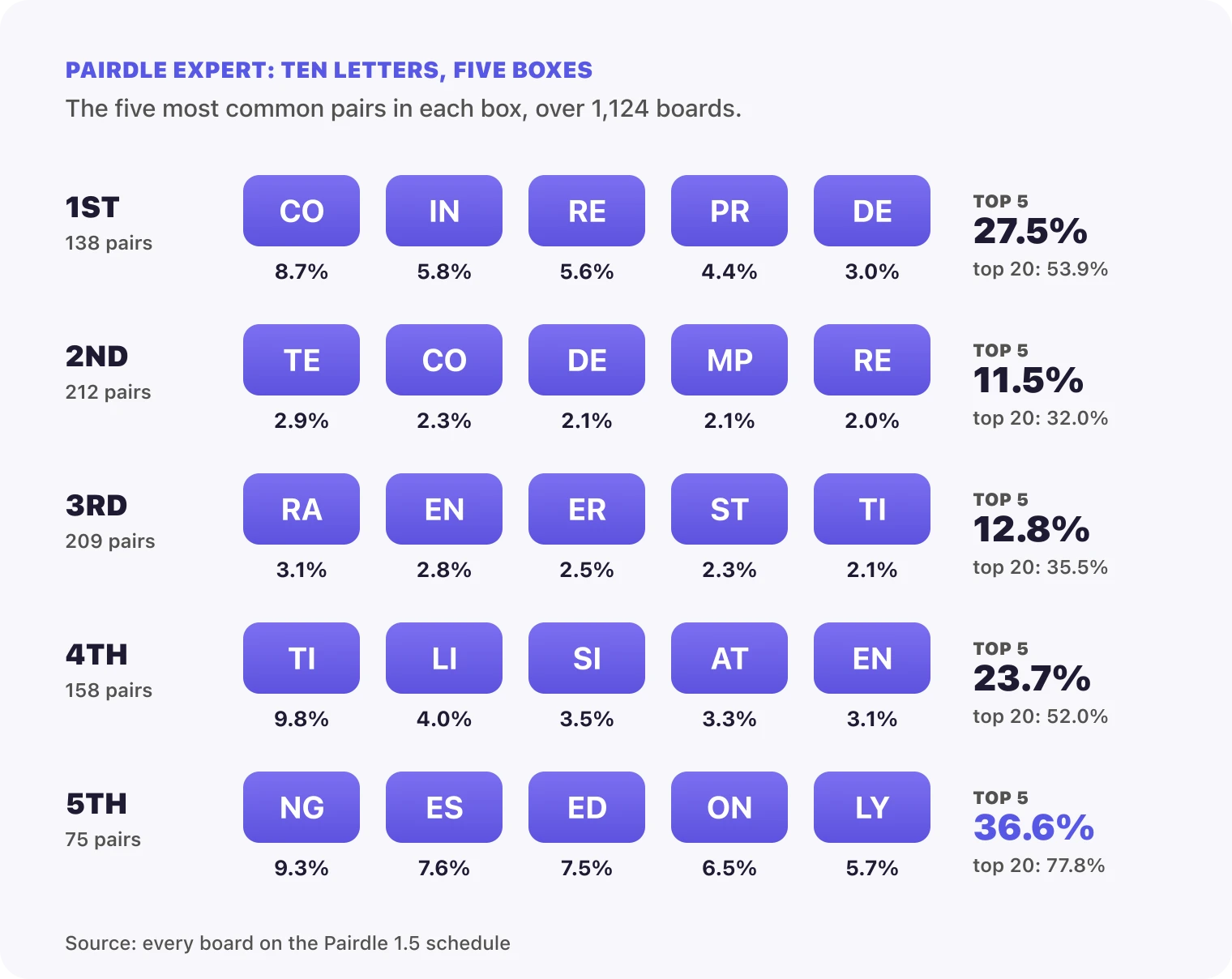
The ends are where it's easy. The 5TH box uses only 75 different pairs, and its top twenty cover 77.8% of answers, the most predictable box in any Pairdle level. NG 9.3%, ES 7.6%, ED 7.5%, ON 6.5% and LY 5.7% lead it.
The front is sharp too. In 1ST, CO alone is 8.7% of answers, with IN 5.8%, RE 5.6%, PR 4.4% and DE 3.0% behind it, for a top five of 27.5%. Ten-letter words are mostly built from a prefix, a root and an ending, and the prefix list is short.
The 4TH box has one big favourite: TI, at 9.8%, the -tion and -tive words. The 2ND and 3RD boxes are the flat ones, with top fives of 11.5% and 12.8%. So in Expert, the order is: 5TH, then 1ST, then 4TH, and leave 2ND and 3RD for last.
Three Expert pairs are locked to a single box. LY and RY only ever land in 5TH, IZ only ever lands in 4TH (AUTHORIZED, FERTILIZER), and no ten-letter word on the list puts any of them anywhere else.
The playbook
Here's how I play now that I've seen the numbers.
1. Solve the ending first
The last box has the most concentration and the fewest options at every level, so it's where a guess buys the most. Scan the tiles for ED, ER, ES, NG, LY (in Pro, ED and NG above all) and ask whether the word could be a past tense, a plural, or an -ing word. It often can.
2. Then the front
With the ending fixed, the word usually has a shape. Now work FIRST, where prefixes and consonant pairs give you real structure to lean on.
3. Let the middle fall out
Don't try to win MID. Once both ends are locked there are rarely many words left, and the middle is often forced. That doesn't make the middle box useless. See step 6, where it turns into the best probe you have.
4. Give yourself about a minute to hunt for a real word, then stop looking
This took me the longest to learn. If you've stared at the tiles for a minute and no word has come to you, more staring won't produce one. It will produce a guess built on a hunch, and a hunch that comes back grey teaches you little. Do put the minute in first, though. Word-spotting gets better with practice, and the more you play the faster real words jump out of the tiles. Frequency tables can't do that part for you. If you want to practise without touching your streak, Practice mode gives you unlimited boards at every level.
5. If you do see a real word, guess it
The odds are good, though not as good as they first look. Every Pairdle board is built from four real words, and one of them is the answer. The other three are there to hand you plausible pairs. If the word you found is one of those four, it has a one-in-four chance of being the answer.
The catch is that boards spell more than their four words. Cross a pair from one word with pairs from another and you often get a fifth or sixth real word. The 13 September board was built from TRADED, APIECE, SPENDS and TELLER, but its tiles also spell TRADER and TRENDS.
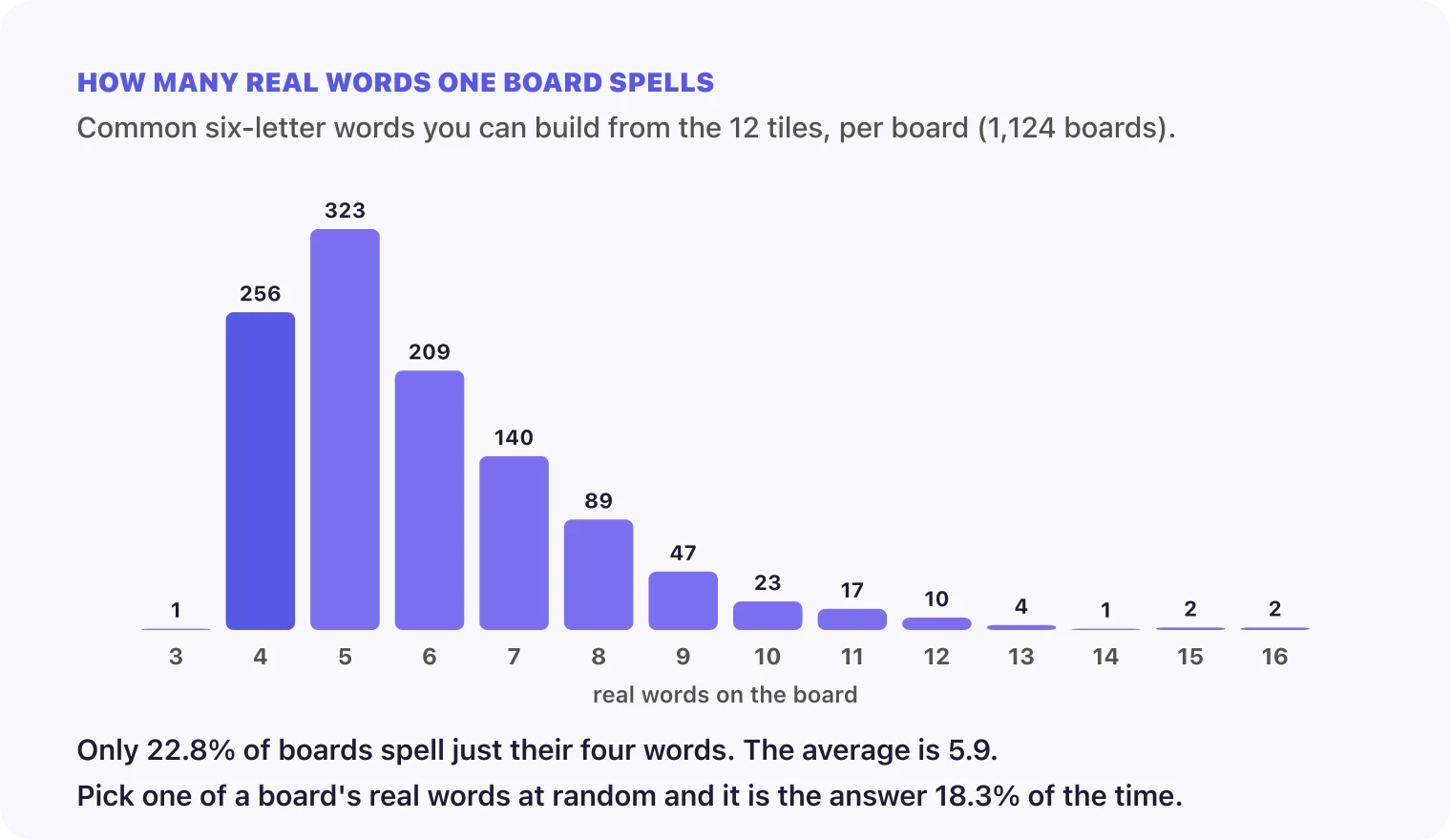
Across the schedule, only 22.8% of Pairdle boards spell exactly their four words. The average board spells 5.9 common words. So a real word you've found, picked with no other clue, is the answer 18.3% of the time: a little under one in five. In Pro that's 20.9%, and in Expert, where long words rarely cross by accident, it's 22.1%.
That's still a strong play for a puzzle that gives you six guesses, and a wrong real word still colours three tiles. If you see DEFEND in the tiles, play DEFEND. If you want to see how that odds game shows up in real wins and losses, we measured Pairdle's own guess distribution against Wordle's.
6. Use the middle box as a probe
There's one row of boxes now, so every guess is a single try at the word. That makes MID the cheapest box to spend on information: it's the box where a guess is worth least, since even its top five pairs only land 9.3% of the time.
Here's the move. About a third of Pairdle boards (33.3%) have two or more of the top five endings on them, and on those boards the answer ends in one of them 54.0% of the time. When you see two endings, put the more common one in LAST and the other in MID. One guess then tests both.
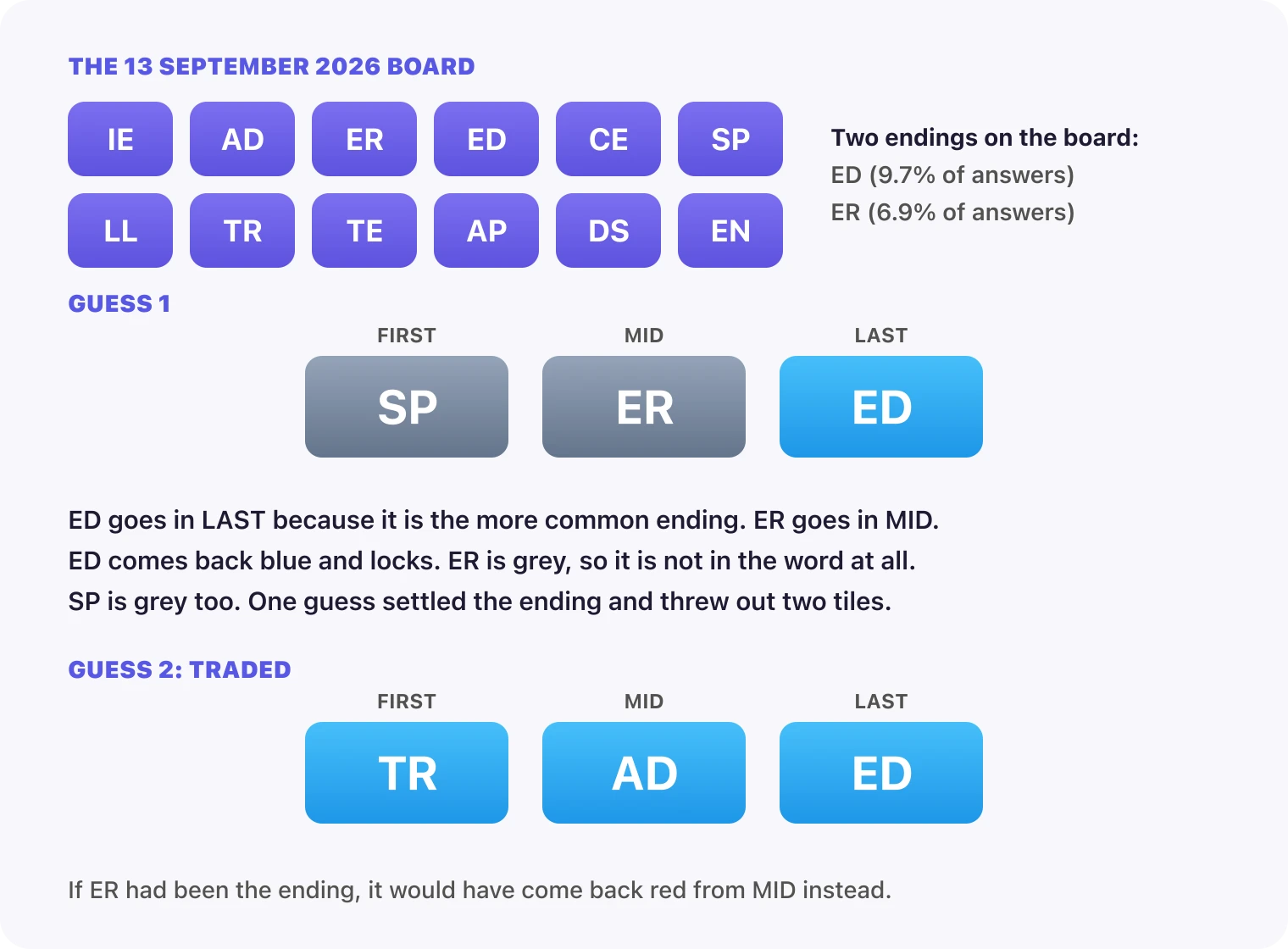
On the 13 September board, ED and ER were both there. Guess one was SP, ER, ED. ED came back blue and locked. ER came back grey, so it wasn't in the word at all, which also ruled out TRADER. Two guesses, done.
If the MID pair comes back red instead, it's in the answer but not in MID, so it's FIRST or LAST. For the common endings that's very nearly settled. Of the answers that hold ED outside MID, 98.2% have it as the ending. ES is 98.6%, ER 96.3%, LY 94.6%, and every one of the 54 answers with NG outside MID ends in it. A red ending from MID has all but handed you the last box.
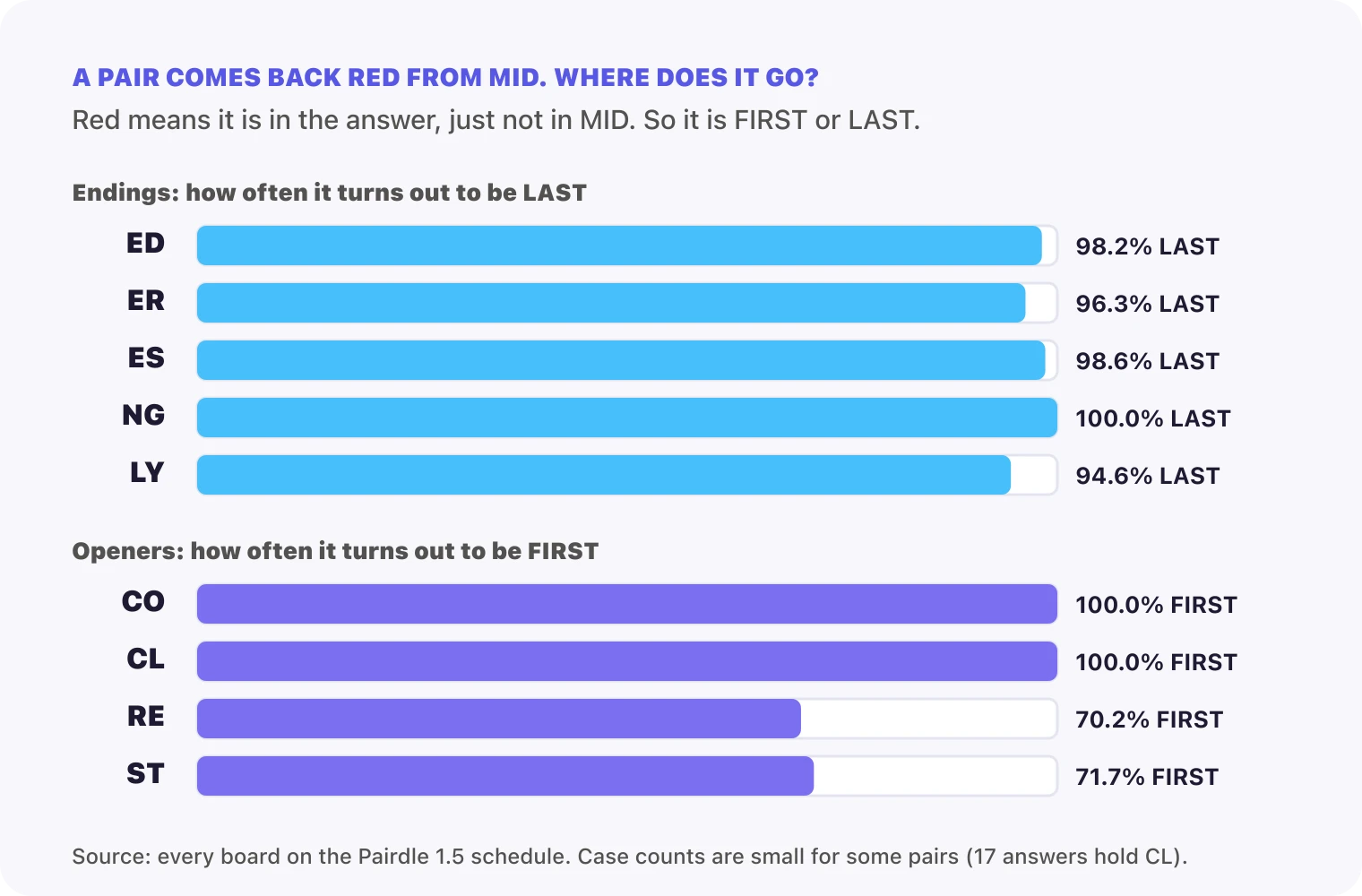
The same read works from the front, but pick the pair with care. A red CO from MID was FIRST in all 23 answers that hold it outside MID, and CL in all 17. RE is only 70.2% and ST 71.7%, because words like NATURE and FOREST exist, so a red RE still leaves you guessing. Probe with the one-sided pairs. Being common is not enough. The counts for some pairs are small, so treat 100% as "nearly always", not a law.
7. When no word appears at all, fill the boxes with each box's likeliest pairs and submit that
This feels like giving up. It's buying information. Three of the 12 tiles belong to the answer, so any tile you place has about a one-in-four chance of being in the word. Pairdle's colours tell you three different things per tile. Blue means right pair, right box, and it locks. Red means the pair is in the word but in another box. Grey means it's out. A red is worth nearly as much as a blue, because it gives you a confirmed pair and rules out a box at the same time.
A hunch guess might solve it and often tells you little. A frequency guess rarely solves it and always tells you something. Over a week of puzzles the frequency guess wins, and it's why a "wasted" guess in Pairdle is almost never wasted.
Want the general-English version of these tables? The most common letter pairs in English covers the dictionary-wide picture. For tactics rather than numbers, try 5 strategies to get better at Pairdle. And for the days when none of this saves you, the 10 hardest Pairdle puzzles according to player data. Or just go play today's puzzle.
By Tim Nye, Logic Loft Games
Related articles
Pairdle Hunt: How to Play and the Math of Hidden Words
Pairdle Hunt is Logic Loft's new word-hunt game, coming soon to iOS and Android. How to play, how scoring works, and how many words hide in one grid.
The 10 Hardest Pairdle Puzzles, According to Player Data
We pulled real player results to rank the hardest Pairdle boards from the game's first months, before Pairdle 1.5, then dug into each day's letter-pair pool to work out why they hurt.
Meowdoku: A Surprisingly Addictive Logic Puzzle
A colorful grid, nine hidden cats, three lives. Meowdoku looks hard at first glance, but the deduction chain that opens it up is pure Sudoku logic.