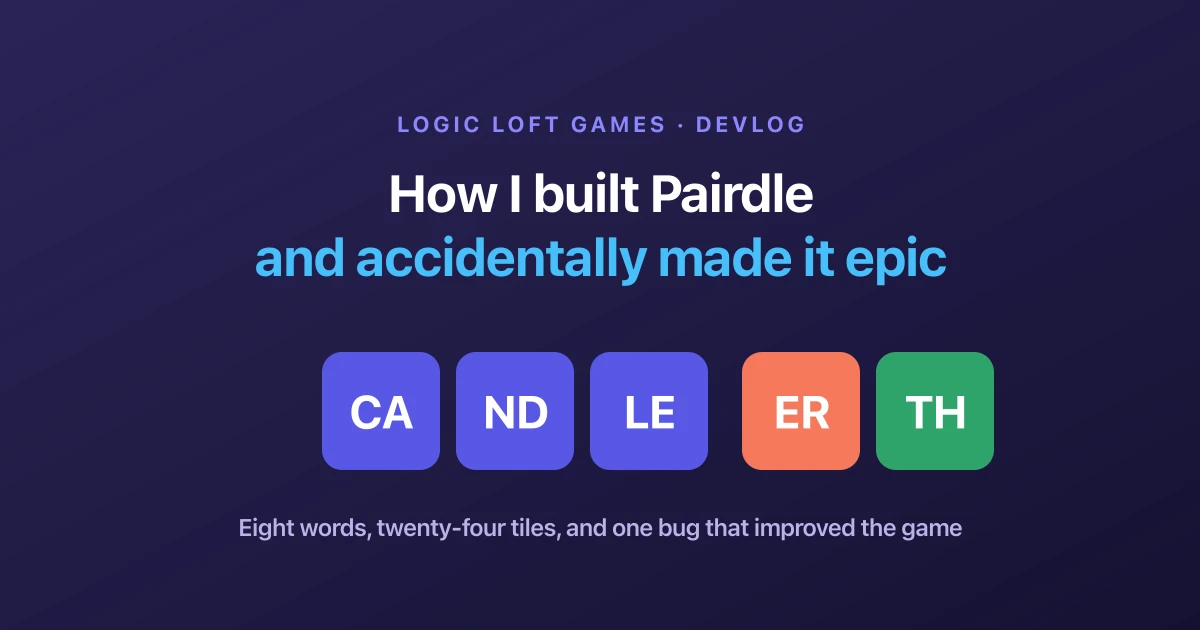
I played Wordle every morning for a long time before I ever thought about building anything.
It deserves the praise. One puzzle a day, six guesses, five letters, and the same word for everybody on the planet. There is no energy meter, no shop, no tutorial. You cannot grind it. When you are done you are done, and you wait until tomorrow like everyone else. That restraint is the design, and it is much harder to pull off than it looks.
The trouble, for me, was that I wanted more of it. Not more puzzles a day. More thinking per puzzle. Once you learn a decent opener and get a feel for letter frequency, a lot of Wordle days turn into bookkeeping. I wanted the part where you sit and stare to last longer.
Everything became an -ordle
I was not alone, because the whole internet had the same reaction at once and the suffix escaped into the wild. Quordle put four boards on screen at the same time. Octordle went to eight, Sedecordle to sixteen. Nerdle swapped letters for arithmetic, Worldle for country shapes.
I want to be careful here, because two things are true at once and people usually only say one of them. Several of those games are good. Quordle in particular is well made and I have played a lot of it, and we recommend a few of them in our roundup of the best daily word games. They are also, to my mind, blatant copies. Take the five-letter grid, the six guesses, the green and yellow tiles, the one-a-day rhythm and the shareable spoiler-free result grid, then run the same loop four times instead of once. A game can be fun and derivative at the same time. Most of that wave changed the quantity of Wordle, or the alphabet it was played in, and left the actual mechanic where they found it.
The bottom of the wave dropped the pretence entirely. Early in 2022 the App Store filled with apps that were simply Wordle with the serial numbers filed off, some charging money for it, at least one charging a subscription. Apple ended up purging them. It was a strange thing to watch, because the game being copied was free and took two minutes to play.
I did not want to add to that pile, at either end of it. Partly on principle and partly on ego. Taking someone else's mechanic and changing the colours is not a fun way to spend six months, and I would rather fail at something of my own than succeed at somebody else's.
So I set myself a rule that turned out to be a good one. Whatever I built had to be different at the level of the mechanic, not the theme and not the quantity. Not Wordle with animals. Not Wordle four times over. A different thing to actually do with your hands.
Pairs were already on my mind
I had a head start I did not appreciate at the time.
I have been writing code since 1980, when I got my hands on a Vic-20, but for most of my working life it sat in the background. I took a biology degree at the Harvard Extension School, did a year of research on ageing and new drugs at Oxford, and started several companies. While I was finishing that degree I took CS50, and my final project was a word game called Pairagrams. It was not commercial and it was not polished, but I had spent weeks with my head inside one problem: letter pairs. How they behave, which ones are common, how differently a word reads when you stop seeing it as a run of single letters.
So when I started sketching, I did not begin from "what could I change about Wordle." I began from the thing I had already been chewing on. What if you never typed a letter at all? What if the smallest piece of the game was two letters stuck together?
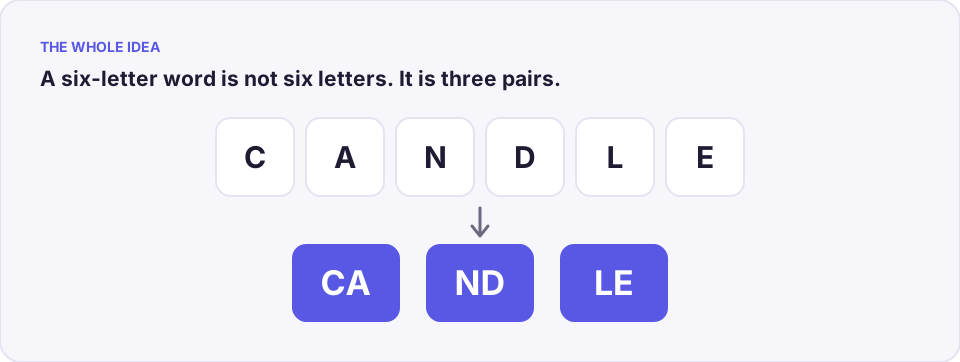
That is the idea, and the moment I drew it I knew it was a real game rather than a re-skin. A six-letter word is not six decisions. It is three. But they are much harder decisions, because you are no longer asking "is there an E in this word." You are asking "does this word contain ND, and if so, does it sit in the middle or at the end?" Your reading brain does not work that way on its own, which is why it is fun. I have taken to calling it Word Sudoku, for reasons I will come back to at the end.
Why six letters, and then eight
I tried four letters first. Four letters is two pairs, and two pairs is not a puzzle. It is a coin toss you win on the second guess. There is nowhere to hide.
Six was the sweet spot. Three pairs gives you a real middle position, which is where most of the difficulty lives, and six-letter words are common enough that the answer never feels obscure.
Eight came later, for people who found six too comfortable, and it is a bigger jump than it sounds. Eight letters is four pairs, and a fourth position multiplies the arrangements you have to rule out. That became Pairdle Pro, which runs the same rules one size up.
Pro is the one I play. With six letters I feel I ought to be able to find the word, to read it straight off the pool rather than work it out by position. With four positions that stops being possible. Either you see the word right away or you do not, and even when you think you see it, it is often not the word.
Attempt one: the board that gave itself away
This is where the engineering started, and where I was wrong twice before I was right.
The answer is three pairs. But three tiles is not a game. You need a pool to hunt through. My first idea was the obvious one: take the answer's three pairs, then fill the rest of the board with random two-letter combinations.
There are 676 possible two-letter combinations. Pulling from all of them gives you a board like this.
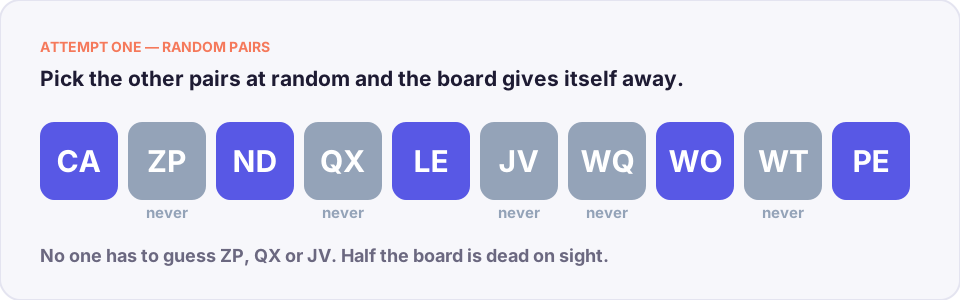
ZP. QX. JV. Nobody has to think about those for even a second. You do not rule them out, you just never look at them, so half the board is decoration. Worse, the tiles that do look like English stand out as the answer. The puzzle solves itself by asking "which of these could possibly be in a word."
A pool is only hard if every tile in it could plausibly belong.
Attempt two: eight real words
The fix was to stop making up pairs and start harvesting them. Take eight real six-letter words, slice each into its three pairs, and put all of it on the board.
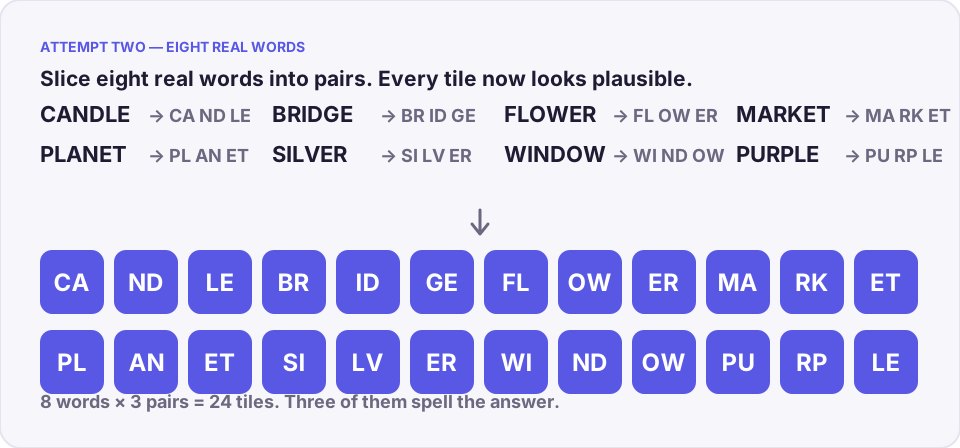
Twenty-four tiles, every one of them lifted out of a real English word, so every one of them could be part of the answer. This was the version that first felt like the game I had in my head, and Pairdle launched this way in February 2026.
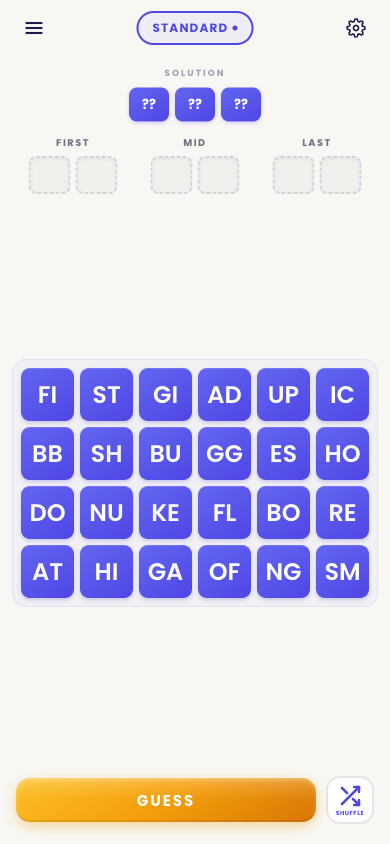
That is the board as it looked at launch. The answer sat somewhere among those 24 tiles, and the other 21 were meant to be real decoys.
Then I hit the bug that took the longest to think my way out of.
The bug: two tiles wearing the same face
Slice enough real words and pairs start colliding. FLOWER ends in ER. So does SILVER.
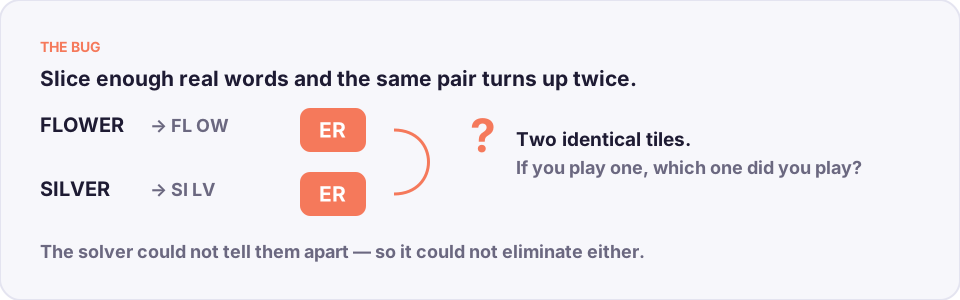
Now the board has two ER tiles that look and act the same, and the game has an ambiguity problem. If you place an ER and it comes back wrong, which ER did you rule out? Neither, really, because they are the same two letters. But the game tracks them as separate objects, and once two objects are interchangeable, the bookkeeping underneath falls apart. Feedback stops being clean and you can no longer trust what you have ruled out. A deduction game has to tell you the truth about that, or it is not a deduction game.
My first fix was to delete the duplicate. That works, but it leaves the board a tile short, and do it a few times and the pool shrinks unevenly from day to day.
The fix, which is also the accident
The version I shipped did something slightly different, and it is the part of Pairdle I was fondest of. When a pair turns up more often than the answer needs, that copy is not deleted. It is swapped for a different pair drawn from a list of the most common letter combinations in English: TH, ER, IN, ST, CH, the pairs your eye accepts without question.
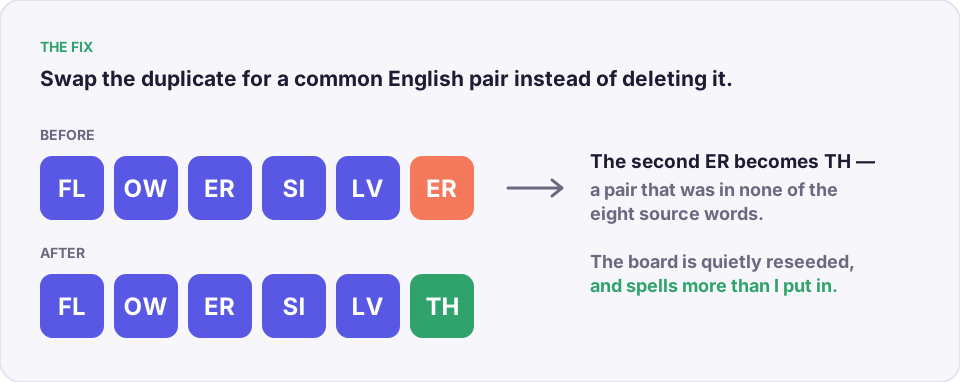
The ambiguity is gone, the board stays the same size, and the replacement looks just as likely as everything around it.
And then the thing I did not plan happened.
Because those substitutes come from outside the eight source words, the finished board ends up holding letter pairs that were in none of the words I fed it. I built that step to fix a bookkeeping bug, and as far as I could tell it had also made the boards a little richer than my own recipe. I was pleased with it. I called it a happy accident and I have told people about it more than once.
Hold that thought.
The exception I nearly shipped over
There is one more wrinkle, and it is the kind of thing that only shows up when a real player finds it.
"Remove the duplicates" is the wrong rule. Some answers need their duplicates.
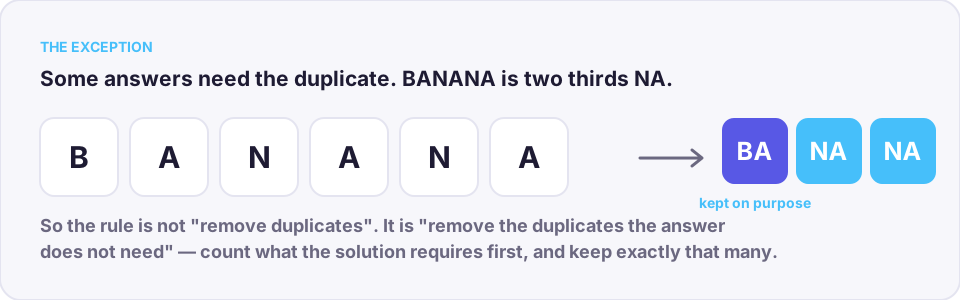
BANANA is BA + NA + NA. If the generator strips duplicate pairs on principle, the board is missing a tile the answer needs, and the puzzle cannot be solved. That is the worst bug a daily game can have, because everybody hits it on the same day. EDITED, CHURCH, ICONIC and SEEDED all have the same shape.
So the rule had to get smarter. Count what the answer needs first, keep exactly that many, and only swap out the extras.
Why I call it Word Sudoku
The closest comparison I have found for Pairdle is not another word game at all.
When I play Sudoku I start pencilling numbers in, follow them until I hit a dead end, then back out and try a different pattern. Pairdle is the same motion. You put ER in the LAST box because ER is a common ending, and then you find you cannot build anything around it. Or you press guess and it comes back grey, and off you go looking for another pattern. The pencilling in is the game. It uses a different part of your brain than hunting for single letters does.
That is also where the two games part company, and it is the thing I am proudest of.
In Wordle you cannot really solve the first guess. There is nothing on the screen to reason from yet, so an opening solve is luck or it is cheating. In Pairdle the whole pool is in front of you from the first second, so a one-guess solve is something you can deduce your way into. Most days you will not, and the hard ones are hard. On the two most punishing boards we have ever shipped, BADASS and REFUTE, players who solved them needed 4.4 guesses on average, and some boards will take you all six. (Those figures come from spring 2026, so read the next section before you take them as current.) But the chance is real rather than a lottery ticket, and that changes how the first minute feels. You are reading, not stabbing.
Pro raises that ceiling again. One guess at four positions is hard and I miss far more than I hit. For real puzzle fans, I think Pairdle Pro is the true morning word challenge. Wordle gives you six guesses at a five-letter word, which is a generous allowance, and the two games end up with very different guess counts. If you are still missing at six, it usually is not the puzzle's fault.
Players seem to feel the same way. Two App Store reviews I keep coming back to:
"I like this fresh new take on word games. Easy to place and a good brain challenge!" (Sdreader12, App Store)
"This is my new favorite! It was more challenging than expected (in a good way), so that was a great surprise. Bravo to the dev team." (KLead4D, App Store)
NEWS FLASH, 8 August 2026
I was most of the way through writing this article when I decided to check a number.
I wanted to say how many words a typical board can spell, so I replayed the generator over every puzzle we had ever built. The answer came back: about five. That felt low. It is a board made from eight real words. Five felt much too low.
So I looked at what the generator was actually producing, tile by tile, and found this.
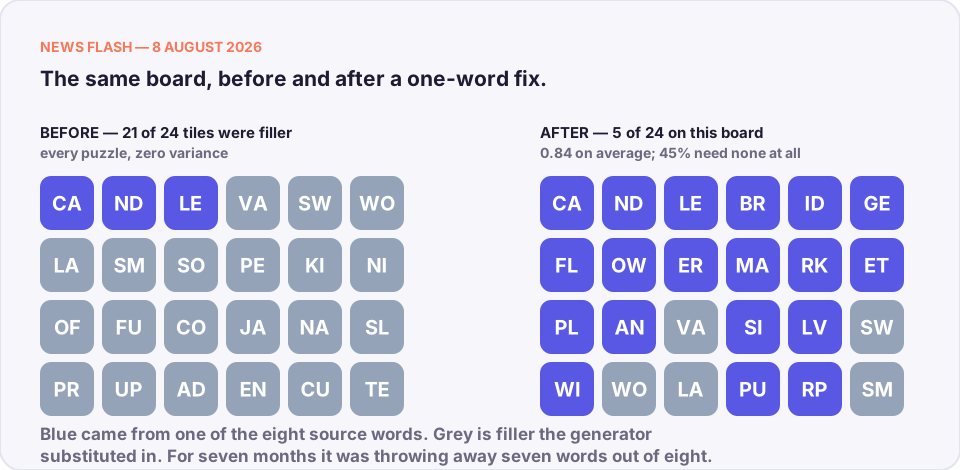
It was substituting twenty-one of the twenty-four tiles. Every puzzle. Since December.
Not the duplicates. Almost everything. Of the eight words I so carefully harvested each day, the board kept the three pairs that spell the answer and threw the other seven words in the bin, replacing them with generic filler off the common-pair list. The decoys a player spends six guesses reasoning about were not decoys at all. They were wallpaper.
The cause is one word long. The code counted how many times each pair is required, then swapped out any copy beyond that allowance. That part is right, except the allowance was built from the answer alone and defaulted to zero. So every pair that was not in that day's answer had an allowance of nought, and the first time the generator met it, out it went.
const required = requiredCounts.get(letters) || 0;   // any non-solution pair -> 0
if (seen > required) { substitute(); }               // ...so 1 > 0, swap it
The fix is Math.max(1, ...). Keep the first sighting of every pair, and let the answer's own needs raise the allowance where a word like BANANA calls for two. One word. The broken line shipped on 30 December 2025 under a commit message that reads "fix paridle missing letter pairs", with a comment above it that correctly describes the behaviour it did not have.
Nothing failed. That is the part I keep turning over. No test broke, no error showed up, and the board still looked completely plausible, because filler drawn from the most common letter pairs in English is built to look as convincing as the real thing. It took seven months and a spare afternoon fact-checking my own blog post.
Here is what the fix changed, measured across all 1,124 standard puzzles:
| before | after | |
|---|---|---|
| tiles replaced with filler | 21 of 24 | 0.84 of 24 |
| boards needing no substitution | none | 45% |
| words a board can spell | median 5 | median 22 |
So the honest version of this article's title is that I did not accidentally make it epic. I accidentally made it thin, told myself a nice story about why, and only caught it because a number looked wrong and I could not leave it alone.
The good news, in August, was that the game had gone back to the one I designed in the first place. The board was made of eight real words again, the decoys were real decoys, and those pieces recombined into far more words than I ever put in: around twenty-two on a typical board rather than five. That was never the substitution's doing. It was the eight words all along.
If you had been playing since the spring, it got harder that week, and it was not your imagination.
That was the board as it stood in summer 2026. In version 1.5, in September 2026, I made it smaller again, this time on purpose. After a lot of feedback from our players, we decided to simplify the game without removing the challenge. New players were reading the old two stacked rows as two separate puzzles.
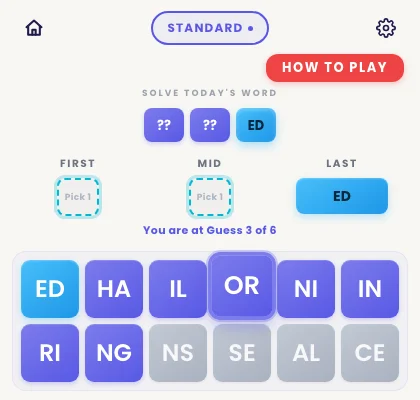
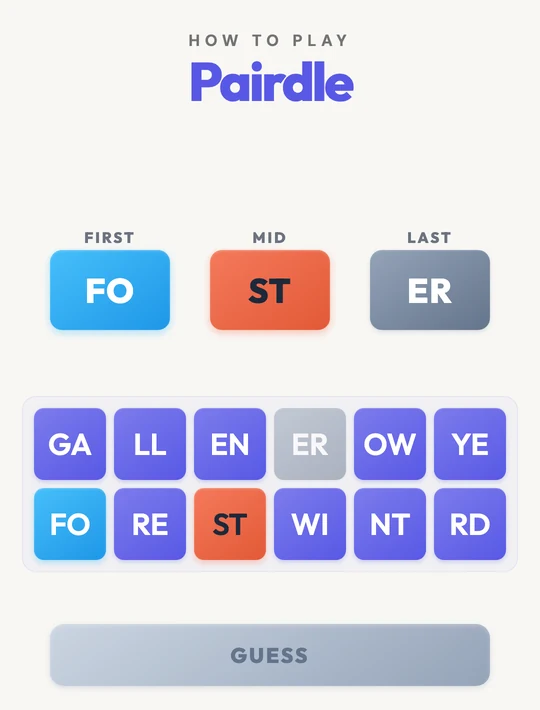
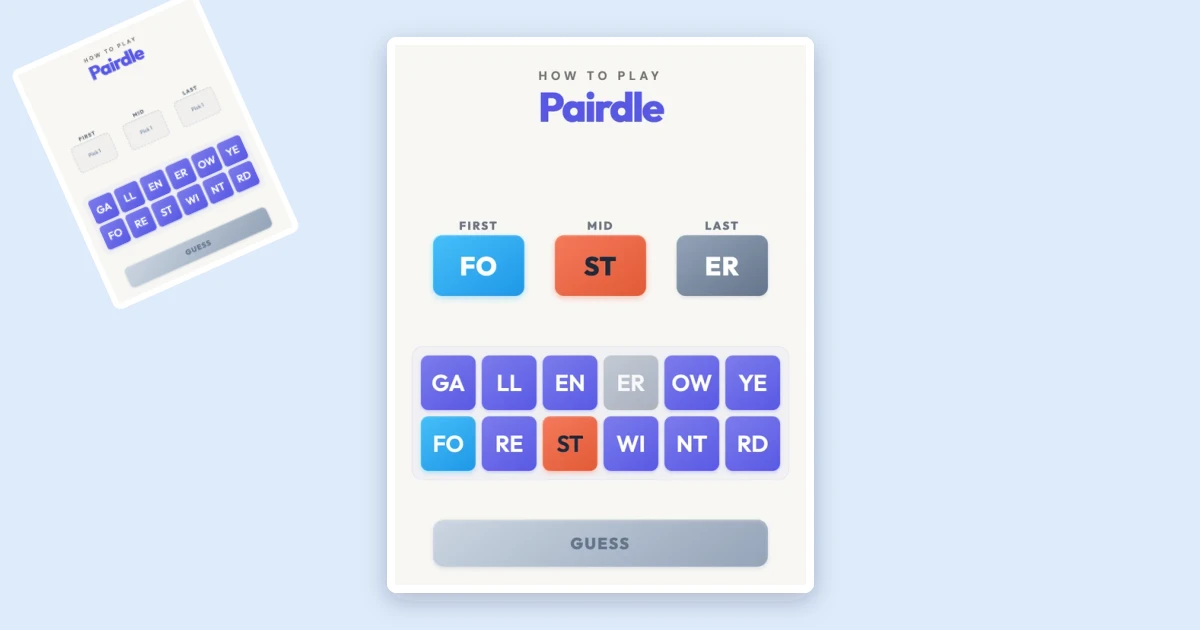
So now there is one row of boxes. In Pairdle the answer is a six-letter word, with three boxes (FIRST, MID and LAST) and 12 tiles. Pro is eight letters, four boxes and 16 tiles. There is a new level, Expert, with ten letters, five boxes and 20 tiles. The old Standard, Challenge and Championship tiers are gone. You get three levels, Pairdle, Pro and Expert, with one board each per day.
The lesson from the bug stayed in. Every board is four real words of the same length, cut into two-letter pairs, with no pair shared between them. One of the four is the answer and the other three are real decoys.
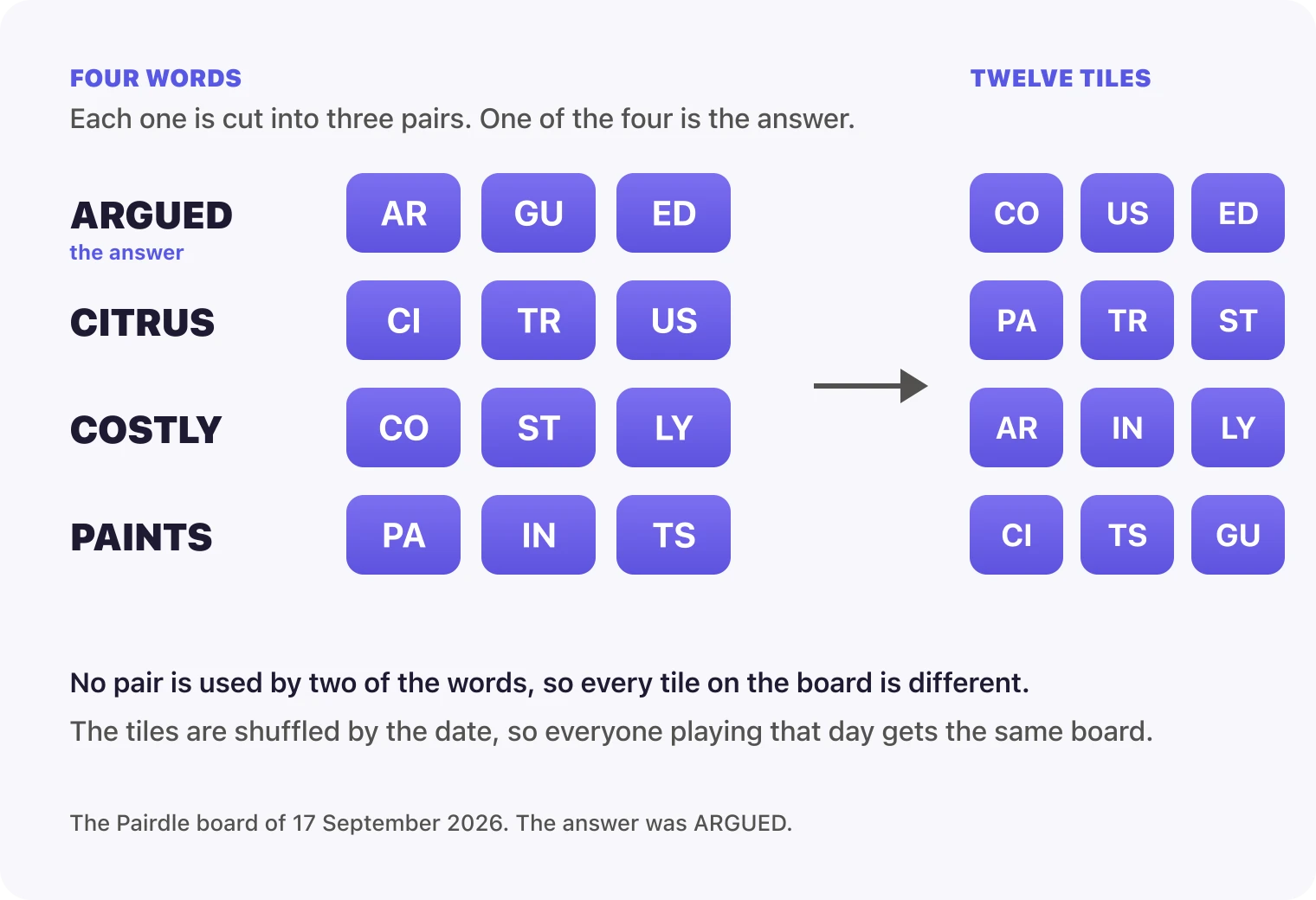
A smaller pool means fewer words to find. Across all 1,124 scheduled Pairdle boards, you can spell about 6 real words on average, with a low of 4 and a high of 16. On Expert it is under 5. The colours work like this: BLUE is the right pair in the right box, RED is in the answer but in the wrong box, and GREY is not in the answer at all.
What I would tell myself at the start
The mechanic came from a student project I had half forgotten. The hardest part was never the idea. It was the attempts I had to throw away, each of which looked completely reasonable until I actually played it.
And the thing I was proudest of turned out to be a defect I had been describing as a feature, which is a lesson I would rather have learned on somebody else's game. The bug that survives is never the one that crashes. It is the one that produces output you can tell a nice story about. I had the measurement in front of me months ago. What I did not have was the willingness to be suspicious of a number that flattered me.
If you want to see where all this ended up, today's Pairdle is here, and there is a fuller walkthrough of the board in how to play.
I still play Wordle most mornings.
Related articles
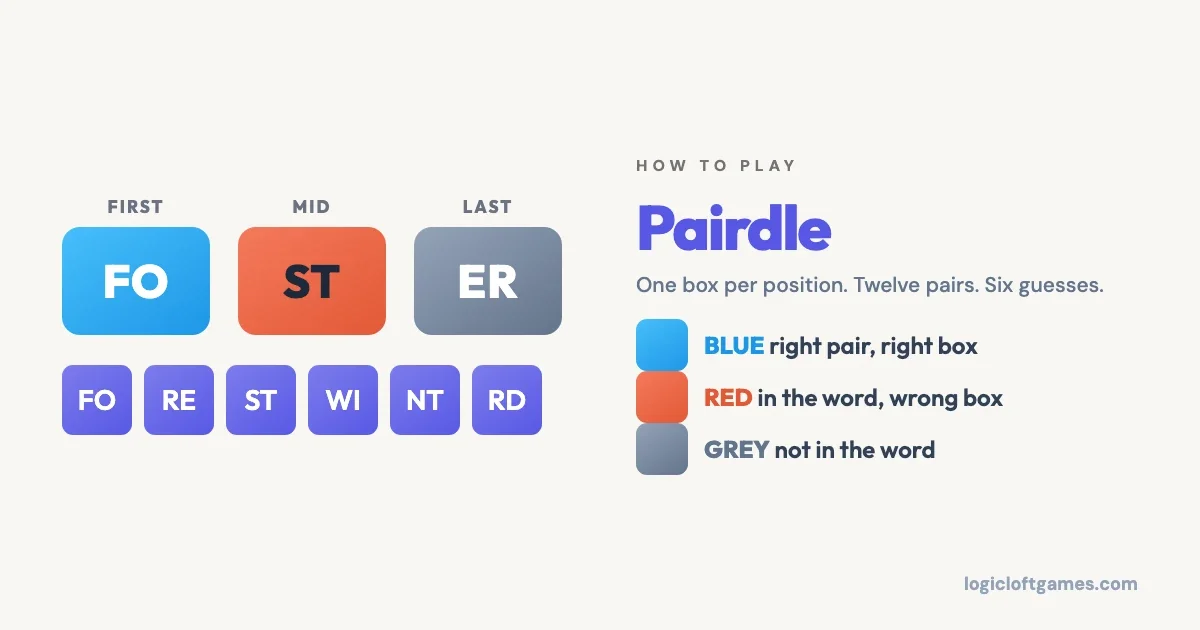
Pairdle 1.5: What's New, What's the Same, and an Exciting New Level
Pairdle 1.5 puts every level on one row, unlocks Pro, adds Expert and endless Practice, and introduces Olly the owl. Plus what a 12-tile board really holds.
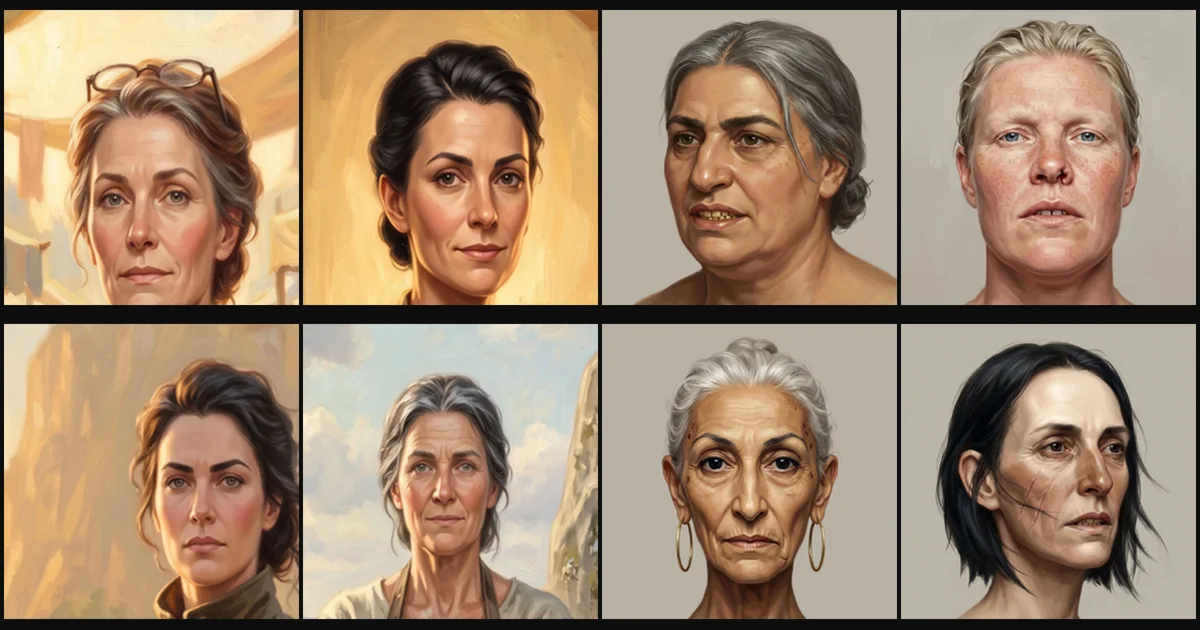
Making 52 Consistent AI Character Portraits: What Went Wrong
I used AI to make the art for my word game, and reviewers called it AI slop. Here is what 52 portraits took, with the failed pictures.
5 Strategies to Get Better at Pairdle (From the Team That Built It)
Stuck on today's Pairdle? Five strategies from the team that makes the game: use your first guess to test pairs, read which box a pair belongs in, let grey tiles cross out whole words, and move up to Pro and Expert.