
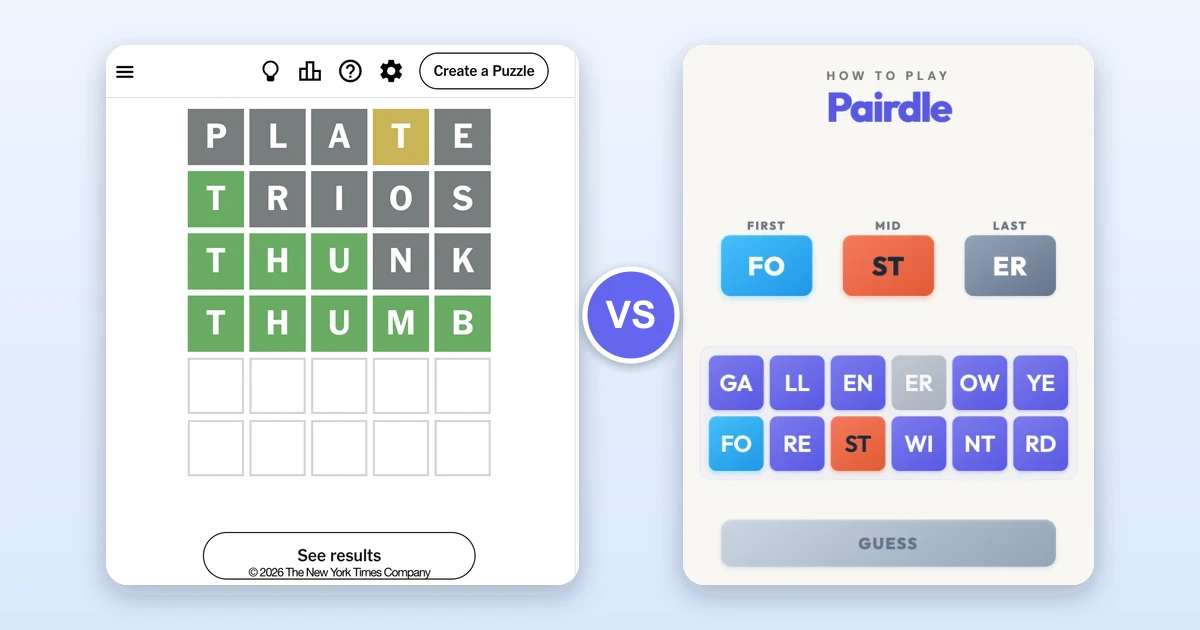
If you play Wordle, you have probably wondered whether the other daily word games are worth your time or just copies. Pairdle is one of those games, and we make it, so read this comparison with that in mind. We have tried to be fair about where Wordle is great and where Pairdle plays differently. "Wordle with a twist" sells both of them short.
Here is the side-by-side.
The one-sentence version
Wordle: guess a five-letter word, one letter at a time, using colour feedback to narrow it down over six tries.
Pairdle: find a hidden six-letter word by placing letter pairs, two letters at a time, into three boxes (FIRST, MID and LAST), with six tries and colour feedback on every pair.
Both are one puzzle a day, and both give you that "narrow it down" feeling. The big difference is what you work with: single letters in Wordle, pairs in Pairdle.
Side-by-side
| Wordle | Pairdle | |
|---|---|---|
| You place | One letter per cell | Letter pairs (two letters at once) from a board of 12 tiles |
| Feedback | Green / yellow / gray per letter | Blue (right pair, right box), red (in the word, wrong box), grey (not in the word) |
| Core skill | Vocabulary recall + letter frequency | Pattern deduction + positional logic |
| Guesses | Six | Six, at every level |
| Difficulty | One daily puzzle | Three levels: Pairdle (6 letters), Pro (8 letters), Expert (10 letters) |
| Daily cadence | One puzzle a day | One board per level each day, plus unlimited Practice |
| Feels like | A vocabulary sprint | A logic grid (closer to Sudoku) |
Where Wordle shines
Wordle works because there is almost nothing to learn. Five boxes, six guesses, go. That is why it became a daily habit for so many people. It rewards a wide vocabulary and a good feel for common letters, and one lucky guess can win the day. If you want a two-minute puzzle every morning with no setup, Wordle is close to perfect. (If you play it, our best Wordle starting words and how to play Wordle guides will help, and if you want to see where that reliability breaks down, we ranked its hardest answers on record.)
Where Pairdle is different
In Wordle you can type any word you like. In Pairdle you build your guess from tiles already on the board. Each board is made from four real words cut into two-letter pairs, with no pair shared between them, and one of those four words is the answer. Everyone gets the same board that day. So the question is less "what word fits?" and more "which three pairs belong, and in which boxes?" That makes it play more like a logic puzzle than a spelling test. Some examples:
- Pairs tell you about position. If
ENcomes back red, you know it is in the answer but in a different box. If it comes back blue, it locks in place. Reading those colours box by box is the main Pairdle skill. - Ruling pairs out does most of the work. Good players win by crossing off grey pairs and narrowing the boxes, the same way you solve a Sudoku by removing what can't go in a square, not by guessing the answer outright.
- You pick the level. Pairdle is a six-letter word in three boxes. Pro is eight letters in four boxes, with 16 tiles, and it is free for everyone, on the web too. Expert is ten letters in five boxes, with 20 tiles. Wordle has one difficulty. Pairdle lets you pick how hard it gets.
- Each guess tells you more. You place three pairs at once in Pairdle (four in Pro, five in Expert), so one guess can tell you which pairs are in the word, which are not, and where the right ones go. You are juggling several clues from the first guess, a bit like opening a logic grid.
The board also holds more real words than just the four it was built from. Over every scheduled board, you can spell about 6 real words on an average Pairdle board, and a little under 5 on an Expert board. That means a guess that spells a real word can still be wrong, which is part of the puzzle.
If you like crossing things off until one answer is left, it is the same thinking we describe in our how to play Sudoku guide. Pairdle sits somewhere between Wordle and Sudoku: part word game, part logic.
Which should you play?
Both, since they give your brain slightly different work.
- Play Wordle when you want a quick, familiar puzzle that leans on vocabulary.
- Play Pairdle when you want more deduction, more thinking about position, and levels that get harder as you get better.
They go well together because they are not the same game. Plenty of our players do Wordle and Pairdle back to back. One warms up your word recall, the other your logic.
Is Pairdle "just Wordle with pairs"?
They do share a lot: a daily puzzle, colour feedback, a hidden word to work out. But playing with pairs instead of single letters changes the kind of thinking the game asks for. Wordle is a word game with some logic on top. Pairdle is a logic game with some words on top. After a week of both you will feel the difference.
The best way to judge is to try it. You can play today's puzzle free at Pairdle. Tap a tile to place it, or drag it where you want it, and press GUESS once every box is full. On your first board, Olly the owl walks you through it. If you want more boards without touching your streak or stats, Practice has as many as you like. Bring your Wordle habits and see which ones help and which ones you have to drop. For a head start, our 5 strategies to get better at Pairdle turns a lot of Wordle habits into Pairdle terms, and if you played before, what's new in Pairdle 1.5 covers what changed.
Either way you get two daily puzzles, and two slightly different workouts for the same word-loving brain.
If you want to see that deduction on paper, a reader wrote up her own pen-and-paper Pairdle solve diary: three handwritten columns, a wrong guess, and the note-taking mistake that gave it away.
Related articles
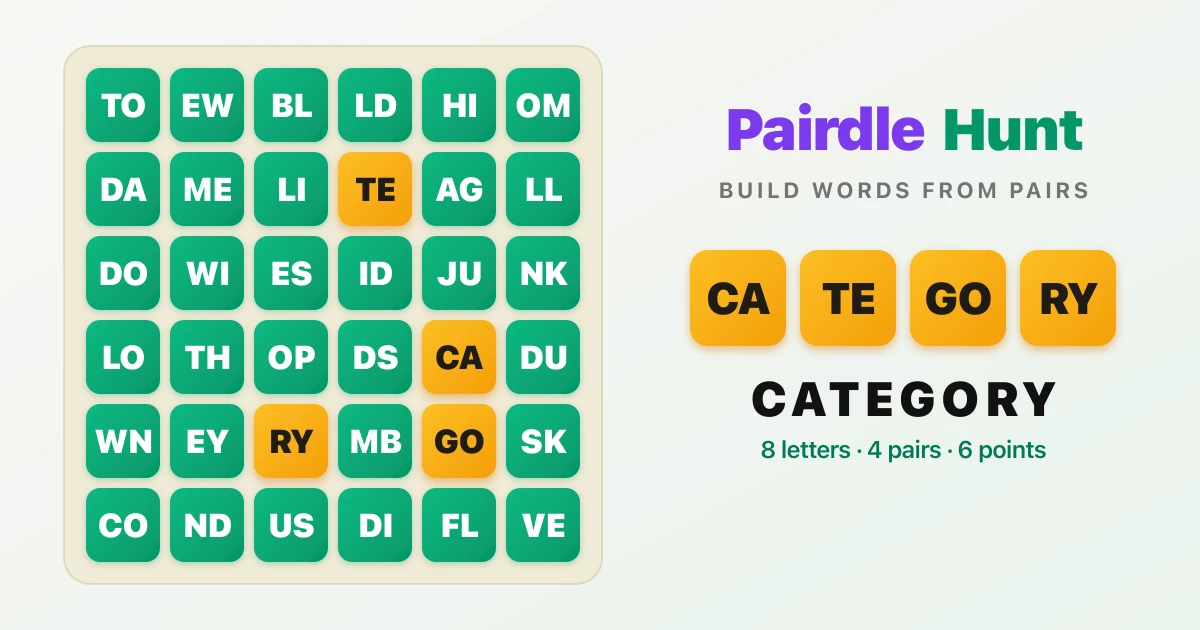
Pairdle Hunt: How to Play and the Math of Hidden Words
Pairdle Hunt is Logic Loft's new word-hunt game, coming soon to iOS and Android. How to play, how scoring works, and how many words hide in one grid.
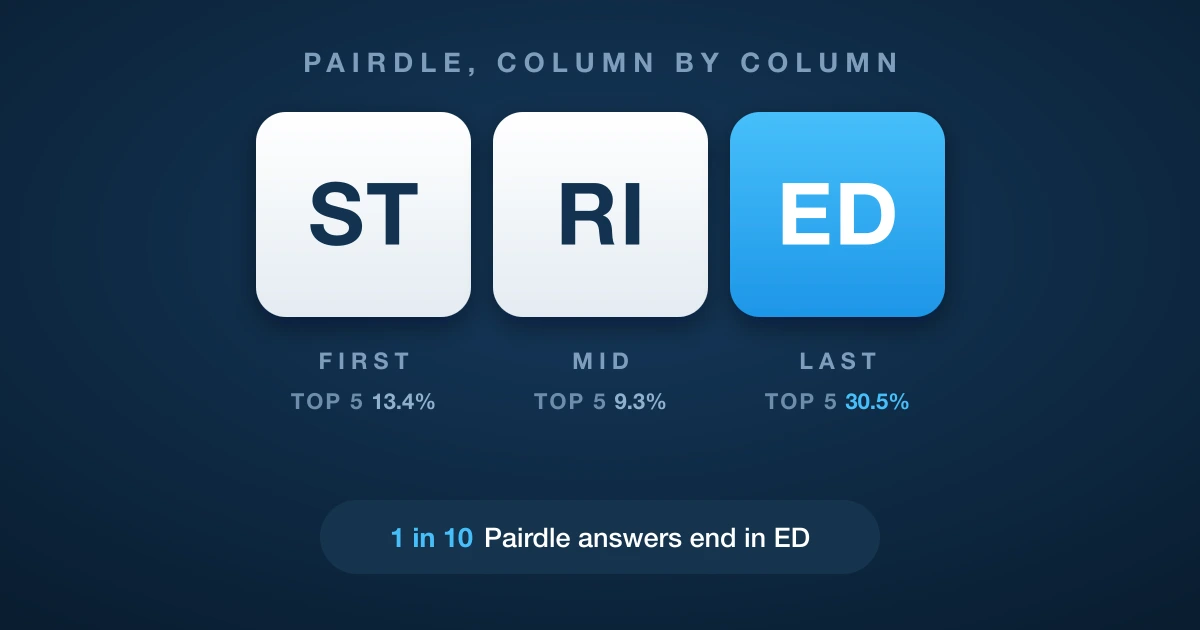
How to Master Pairdle, Column by Column
I counted the letter pairs in every answer on the Pairdle 1.5 schedule. The three boxes are nothing alike, and the last one is by far the easiest to call.
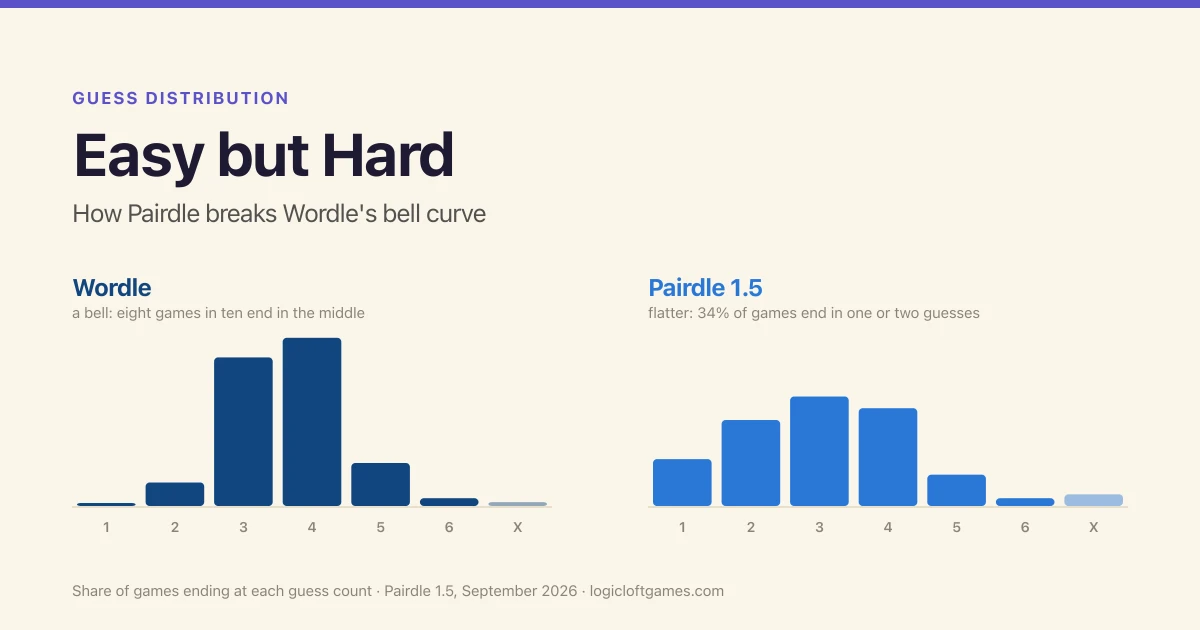
Easy but Hard: How Pairdle Breaks Wordle's Bell Curve
Wordle's guess distribution is a tight bell. Pairdle's isn't. Players win faster and lose more often. We pulled real data to find out why.